
DaveG38
-
Posts
1,745 -
Joined
-
Last visited
-
Days Won
20
Content Type
Profiles
Forums
Events
Downloads
Store
Gallery
Articles
Everything posted by DaveG38
-
Rare but largly unknowns
DaveG38 replied to DaveG38's topic in British Coin Related Discussions & Enquiries
Not necessarily, it may be the case that dies were prepared but in the event were not used. This makes overdates more likely, why throw away perfectly good unused dies just because the year is wrong? Simple solution... change the year. I think you are quite right that the dies were prepared in readiness, but simply weren't used for 1847 and then were recut for 1848. My guess is that the coin I saw in Coin Monthly, which was only in fair/fine condition at best and had obviously been in circulation, was some kind of trial striking to see how the dies stood up and was simply dumped into circulation by the mint - after all they weren't there to engineer a rare date for the collector, and they probably saw this as a useful way to get some use out of the trail strikings. For me the interesting thing is whether there were any more, whether they all eventually got melted down, or whether there are others out there. also, of course, where is the example from CM? -
Hi all, I have just been reviewing some old coin monthly mags from the1970s - sad isn't it? And I came across a couple of what were referred to at the time as 'reader's rarities' and I wondered if any body knew what happened to the actual coins and if any others have been discovered. One such was the 1671 Charles II crown with the quarto edge date, of which I have an example, and I have come across a couple of other examples over the years, but I have never seen another 1847 sixpence, nor have I found a 1903/2 penny. These last two seem to be as rare as the 1954 penny or the 1952 halfcrown, but have never had quite the same hype. Does anybody know anything about either of these? There are other coins, but these are two which stood out for me.
-
Books about Coins
DaveG38 replied to £400 for a Penny ?'s topic in British Coin Related Discussions & Enquiries
Currently my constant companions are Dave Grooms Bronze coin Varities and Dereks grading British Coins, probably in that order. Gary Gary, Thank you very much for the free 'plug.' However, I really don't see my book as well written as its aim was always to just layout all the indicators for collectors, more a case of extensively researched, I feel. From some of your 'finds' lately, I get the impression it's done you well as a source book, for which I'm pleased. I don't know if you are into silver as well as bronze, but if so, then watch out for the sister book, 'The Identification of British 20th Century Silver Coin Varieties.' I've just about finished all the pre-decimal material and am just stating the research for the decimal series. Should be ready in a few months and contains many varieties either not described in Davies or which are just given a passing mention. As in the case of the bronze, I have tried to include all the features from all the sources, so that it is easy to unambiguously distinguish the types. -
Rarest Circulation Coin?
DaveG38 replied to PatrickCoin's topic in British Coin Related Discussions & Enquiries
I'm still having trouble finding and example of the dot to dot 1992 10 pence and the 20 pence of that year with the earlier (smaller) effigy. I am beginning to think that the only way will be to go to the bank and search through bags full of change to find them. They certainly don't turn up in the pocket!! -
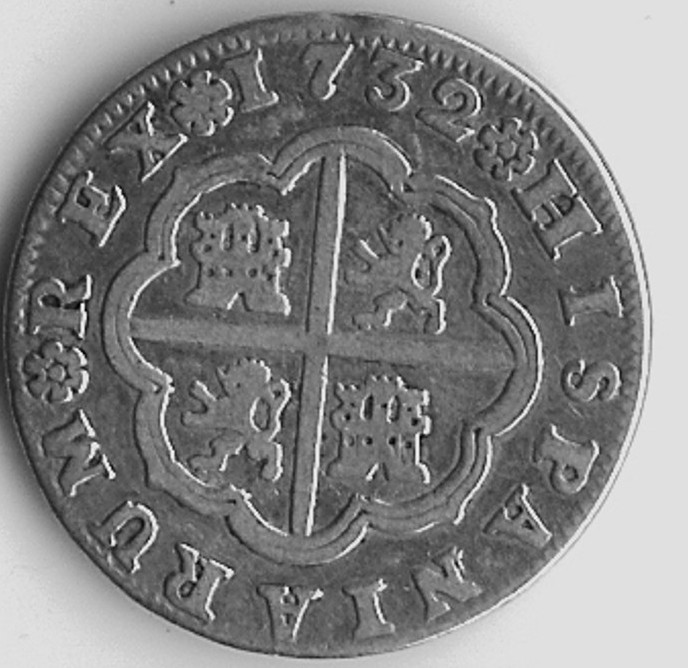
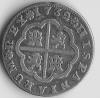
Here's the reverse.
-
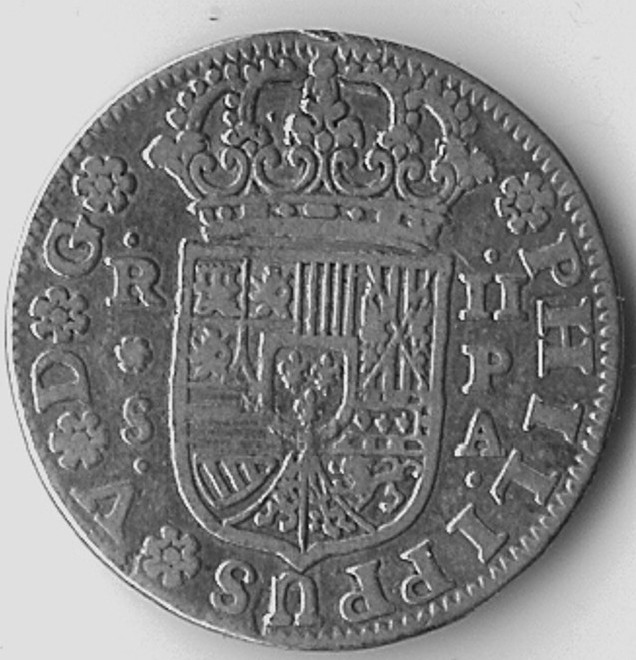
Hi, Any views on what I should expect to sell this Philip silver coin for? Its 1732, 2 reales (I think) and is really quite nice, albeit probably only Good fine. Obverse on this post, reverse on the next.
-
Help, I'm confused dot com! My latest version of CCGB is 2007 (I buy one every few years) and I have been checking out the details of the 1911 shilling. According to Davies, there are 3 obverse and 1 reverse for this year giving 1+A, 2+A and 3+A types. According to CCGB2007 (and earlier issues e.g. 1998 and 1990) the 1911 shilling comes as 2 obverse and 2 reverses all fully meshed to give 1+A, 1+B, 2+A and 2+B. However, the differentiator for the reverses is the pointing of the 'I' in 'GEORGIVS.' The problem is that this inscription appears on the obverse NOT the reverse, so my questions are: 1) Are there 4 obverses based on the combinations of hollow/flat neck and 'I' to a bead/space or just the 3 reported by Davies? If Davies, the non-existent one is the flat neck with 'I' to a space combination. Anybody got one? 2) Are there any reverse die types other than A that anybody knows about? If so what are they paired with? 3) Is this error put right in later CCGBs? DaveG38
-
Hi Everybody, Does any body know when the Coin Monthly mag ceased publication? I know when it started and I have got most of the 1970s issues plus plenty from the 1980s. When it comes to the 90s, I have a few from 1991 and 1992, but its pretty obvious from the contents that they were getting very thin and were obviously running out of steam. So can anybody help with a final date or volume/issue number? Thanks.
-
Edward VII shilling variants
DaveG38 replied to 1949threepence's topic in Confirmed unlisted Varieties.
A final thought. It looks like there 's an Obv 2a for 1903, 1904 and 1906, so logic says there might be one for 1905? Anyone willing to check theirs to see? PS: Thanks to Gary D for confirming the 1905 Obv 1 type. -
Edward VII shilling variants
DaveG38 replied to 1949threepence's topic in Confirmed unlisted Varieties.
1949 Threepence, Thanks for this. I followed the link to Michael Gouby's website, but didn't scroll all the way down the page. Smack on wrist and write 100 times 'I must look more thoroughly in future.' -
Edward VII shilling variants
DaveG38 replied to 1949threepence's topic in Confirmed unlisted Varieties.
Hi all, At the risk of going into anorak mode, can I just clarify our collective understanding about these Edward VII shillings? As I see it there are: 1902 - Obv 1 1903 - Obv 1 and Obv 2a (as newly defined) 1904 - Obv 1 and Obv 2 1905 - Obv 2 with Obv 1 reported by Davies but unconfirmed. 1906 - Obv 1, Obv 2 and Obv 2a (the latter as found by Onewebby) 1907- 1910 - all Obv 2. Somewhere in this thread there is mention of a 1904 with Obv 2a, but no reference to where this came from. Its not on the Michael Coins website, so I wondered if anybody can enlighten me as follows: 1. Is there an identified Obv 2a for 1904? 2. Can anybody confirm an Obv 1 for 1905? 3. Does my list above represent the known state of tis series or is there anything else lurking about? Thanks. -
Two more coins 1940 DE and 1939
DaveG38 replied to rolling's topic in British Coin Related Discussions & Enquiries
Reference the 1940 penny, it certainly looks like a double exergue line type, but it may be the way the light strikes it that makes it appear so. The other test that you can try in hand, but isn't visible in the picture, is to check whether the waves above the line actually sit on the line or are slightly above it. If on it, then its a single exergue type. If above it then its a double. Now the 1939 is interesting, but not for the reason you have posted. Basically, there are two minor types of 1939 penny, one where the second '9' tapers to a point and one where it has a rounded end. Yours appears to be rounded, as it seems to differ from the first '9' which is pointed. Assuming my interpretation of the photos is correct, then yours is a rounded '9' type which is rather scarcer than the pointed '9'. However, it may just be that wear makes it look thatw ay - you need to judge it in hand to be sure. -
Whilst I agree entirely with the general principle of not cleaning coins, for fear of doing irreparable damage to them, I guess it really doesn't matter too much with decimal bronze. After all none has anything much other than their face value, so a bit of cleaning probably won't do too much harm. I don't have any particular product that I would recommend. However, for cleaning brass/copper in general Hydrochloric acid is extremely effective, but real care is needed to handle it. A 10% solution in water works well at removing surface tarnish - its VERY important that you add the acid to the water and not the other way round. You also need to make sure that you don't breathe in the fumes for the concentrated acid as this is dangerous to your lungs. It's also important not to get it on your skin, or you won't have any!!! Hydrochloric Acid is available commercially as 'Spirits of Salt' from ironmongers. I use it for cleaning brass at home e.g. door furniture, prior to polishing. If all this puts you off then there is an ad on TV for Cillit Bang, which shows a decimal penny being dipped in the product and coming out brightly cleaned. I've never tried it, so I can't say how accurate the ad is, but might be worth trying.
-
Farthing varieties
DaveG38 replied to Kronos's topic in British Coin Related Discussions & Enquiries
Ah, I see what you are getting at. The gaps you are referring to in the Freeman number scheme are the special bronze proofs for those years. For me, these are not strictly varieties but different strike qualities using different dies for the same year. -
Farthing varieties
DaveG38 replied to Kronos's topic in British Coin Related Discussions & Enquiries
I can't see any reference to varieties of the 1954 and 1955 farthings in Freeman?????? CCGB has 1954 665 1955 667 1956 669 and i know of the 2 ruim thicknesses in 1954 I don't wish to be pedantic, but I don't think that Freeman mentions any varieties for the 1954 or 1955 farthings. The rim thickness types for 1954 were mentioned recently on this forum, but I can't see any reference to any 1955 varieties. Can you say what the identifiers are? -
Farthing varieties
DaveG38 replied to Kronos's topic in British Coin Related Discussions & Enquiries
I can't see any reference to varieties of the 1954 and 1955 farthings in Freeman?????? -
Heads up for a bit of copper
DaveG38 replied to Peter's topic in British Coin Related Discussions & Enquiries
I too find Rendel's prices (and grades) a little beyond my expectation. However, don't let your fantasies about Megan go too far. (S)he's actually David Mason, who used to be World Coins in Canterbury, but who took himself off to Spain a few years ago. I think he called himself Megan after his daughter. and here was me fondly thinking Megan was a tall leggy blonde female....... .....curses, foiled again If she's his daughter then she might be a tall leggy blonde. However, David is ginger haired, so maybe strawberry blonde is nearer the mark Keep up the fantasy!! -
Heads up for a bit of copper
DaveG38 replied to Peter's topic in British Coin Related Discussions & Enquiries
I too find Rendel's prices (and grades) a little beyond my expectation. However, don't let your fantasies about Megan go too far. (S)he's actually David Mason, who used to be World Coins in Canterbury, but who took himself off to Spain a few years ago. I think he called himself Megan after his daughter. -
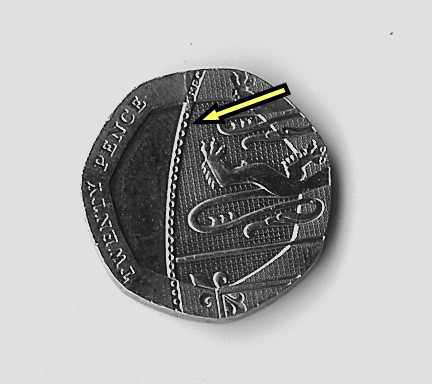
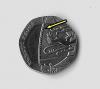
I too have one of these so called '1' 20 pences. Attached is a quick scan of mine - apologies, but the quality isn't that good. What you can't see, but is absolutely clear under a glass is that there is a die crack running from the apparent '1' through the design to the point I indicate with the arrow. Also, when you examine the '1' it is obvious that its just an elongated splash of metal and isn't in any way a design feature. The '1' is also in very low relief with weak edges which is what you might expect as a result of a die flaw or crack. Incidentally, this example also shows the so-called bump on the lion's knee. The mint do seem to have had problems with the 2008 20p don't they?
-
Anyone collect error coins ?
DaveG38 replied to silverdog's topic in British Coin Related Discussions & Enquiries
Personally, I can take an interest in design errors or overdates etc. as these are part and parcel of the minting process. So I can appreciate the error 20p etc. However, I do draw the line at one off errors where the planchet is clipped or where the wrong blank was fed into the machine or whatever. To me these are akin to 'seconds' quality goods. But everyone to their own - whatever turns them on. -
When I was researching varieties for my book on 20th C Bronze, I too tried to find any identifiers for these types, but I am afraid that only Peck seemed to make reference to them in any detail. A couple of other points that may help. Firstly there is also a sharp/rounded pair for 1949 - not mentioned by Peck. Secondly, all the sharp corner types are reported to have a slightly thinner rim than the rounded ones. However, on worn specimens this may not be easy to spot. The only other differentiator is for the 1941 where there are two minor varieties of the sharp corner type, one where the inside corner is sharp and the other where it is rounded.
-
Freeman doesn't say very much about this coin. You are right that its Obv 3 Rev B. According to Freeman there are two types, one in copper and the other in Cupro-nickel. The copper is rated as R17 whilst the Cupro-nickel is R18. R17 is defined as 16-50 existing, whereas R18 is 6-15. Otherwise nothing else. I don't have a copy of Peck at the moment, so can't say what it says about these coins.
-
I've just been reading an older version of 'British Coins Market values' that I own, came across the following paragraph and wondered if anybody can shed some light on what it means. Alternatively, tell me what is so obvious that I'm missing it! The article I am quoting from is about the Royal Mint and the minting process. 'A high-energy burnishing machine was also installed to improve the quality of blanks, as was equipment that implants security devices in coins.' What security devices? Are they all chipped?? For dating purposes the article is talking about new equipment installed in the late 1990s.
-
That's how I started out, collecting from change, 40 years ago. I would love to have been around in those days of circulating lsd. Not that you had that long. It would have been good to have been 12 about 1950, with about 20 good years of collecting from change, possible I may be wrong, Gary, but I would bet that only the older bronze remained in active circulation, and that you hardly ever got older (say pre 1920) silver in your change. Not sure why I say that ~ just a strange hunch. Did you ever get a pre 1860 young head penny from your change ? Hi 1949threepence, I'm not quite of an age where I got a prolonged run at coins from change, but when I was 16 in 1966 I worked for J Lyons teashops during my school holidays and was often employed on the till in the tea shop so I saw a lot of pre-decimal coins on a daily basis. I was also able to swap interesting coins for my fledgling collection, which was fun. However, decimalisation was coming by then and most of the interesting stuff was already gone from change, but not all. You are certainly right that pre-1920 silver material was non-existent - I don't recall getting any. Even pre-1947 was scarce, especially for the 1920s and was always in well worn condition. I never saw any silver Edward VII or Victoria coins. Victorian pennies in completely worn out state were fairly easy to find with pretty much only the date left on them, but they were still thrilling because of their age. Just three gems I found over as many years. First was a 1890 penny in at least GVF maybe NEF. The second was an 1866 Jersey 1/13 shilling in EF, but totally black, not a hint of lustre. I think whoever gave it to me thought they were passing off a foreign coin and getting away with it. The third one was quite extraordinary. A man came in, bought a cup of tea for 6d and gave me a GVF 1826 George IV shilling in payment. I looked at it said, 'what the hell's this then' or something similar. The guy then said 'well its a shilling,' so I shrugged and put it in the till. Later on, I exchanged it for a modern shilling and it still has its place in my collection along with the two above. Its not in the highest of grades, nor is it an uncommon date, but I think it was the trigger for my collecting coins at that time, something I left off during the 1970s and 80s and picked up again in the 90s.
-
Three quid down the Swanee...
DaveG38 replied to Peckris's topic in British Coin Related Discussions & Enquiries
hopefully this link works 1916 penny It certainly looks like a recessed ear type, but as you say the broken tooth is difficult to see on the photo.