
Rob
-
Posts
12,957 -
Joined
-
Last visited
-
Days Won
377
Content Type
Profiles
Forums
Events
Downloads
Store
Gallery
Articles
Everything posted by Rob
-
Maybe, the vendor probably isn't happy with the UNDELIMO edge
-
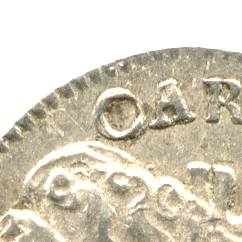
Thanks Teg. I may not be around to reply immediately to your response but will add the following to reinforce what has so far been written. There appears to be at least 4 distinctive styles of 3 (and may be more) which are obviously single punches and these are shown on the scruffy drawing which I append below and apologise for forthwith. There seems to be three types of 3 with a round back to the top section together with at least one type of flat top 3 as used on the 1673 proof Nicholson 017 and others. All of the 5/3 or blundered 3's depending on one's opinion appear to be derived from these 3 types of round back threes shown in drawing 1 below. Type 2 is as shown in the image previously posted and incidentally the least varied in 3D variation although the second clearest 5/3 type with a deep V on the top bar with the divergence taking place just above the mid point. Type 3 is the most obvious overstrike where the horizontal bar of the 5 comes out at the mid point and just above and is flat. This is as Nicholson 021. I have a much clearer image of this variety but won't post it to avoid filling the forum with pictures as you can only add 1 picture per post. Is it possible that this, or any other could be farthing 5 punches? You may be able to shed light on this. Type 4 is the one shown in my previous post which I listed on eBay and appears to be the most common. Type 5 is as the CRAOLVS at the start of this thread where the right hand section of the top bar starts to drop and forms a small V at the mid point. Type 6 is taken from the 1673 halfpenny in next week's DNW auction lot 1436 and is the same coin as listed on Colin Cooke's site which I sold him previously having upgraded to my existing piece. This has a poorly struck final digit with much of the bottom loop weak, but the top bar is very clear and the top curved section of the 3 can be seen descending into what can only be decribed as a T-bar in shape with the vertical part of the 5 in the middle and completely upright. Unfortunately, I have inadvertently deleted this image from my computer so can't show a better picture. Given the number of readily identifiable unambiguous 3 punch varieties, it seems strange to me that so many would need to be overstruck with punches of a different shape. The occasional messy 3 would be OK, but why so many? For your info, all of the above information has been taken from coins in VF or better with the exception of the CRAOLVS and one type 4. The other question in my mind is the length of time that copper was struck (1672-9). Given that only 1672,3 and 5 are known, I presume that other years were struck but bearing one of the 3 dates known. I also would not be surprised to hear of a 1673/2 as the 1672 dies can't all have been worn out. Rob.

-
The note on page 105 in Peck states that 1/2ds were only available from Christmas 1672, giving only 3 months output for this date. Consequently it is not very surprising that the die survived into 1673. If the die was identified as faulty legend it is possible that it could have survived for much longer as it would not have been used except in error and not necessarily thrown away because faulty dies were altered during this period - witness the vast number of William III varieties. What is not known is the number of Charles II halfpennies coined (see Peck p.106), so given the increase in the cost of Swedish copper and their reluctance to mint coins at a net cost to themselves it is likely that the numbers minted were not excessive and potentially not struck as a continuous production. The insistence of making a profit also would encourage the retention and reworking of dies. If, as according to Craig p.174, the operation of coining copper was excluded from the annual accounts of the mint; then copper coin output must have been restricted to a value which was relatively insignificant or else somebody would have had to account for it officially. In this subdued manufacturing environment the possibilty therefore exists that dies would last longer than you may at first think. Don't forget that altered dates regularly exist for the next 90-100 years and very occasionally in the following hundred years or so.
-
The question of altered characters always seems to invoke a lot of debate. The common thread running through all of the 5/3s is the 3 dimensional aspect of the character. The only unambiguous 3s I have seen are the thin line ones. These have rounded backs to the two loops but the angle of the left hand points of the 3 vary from punch to punch. Sometimes the top and middle points are raised, sometimes the middle and bottom points droop. The 3 dimensional relief of the digit is consistent. All of what I would consider to be 5/3 have the underlying thin 3 in its various forms, but there is always the vertical stroke to the 5 and top bar with approximately twice the relief height of the underlying 3 components. The bottom loop of the 5 invariably follows the bottom loop of the 3, sometimes with slight displacement and with a degree of bulging resulting from this. It seems unlikely to me that the top bar of the 3 would vary in relief consistently at the point where the left hand side of the vertical joins it. It also coincides with a change in direction of the top line of the top bar of the 3 - always in the pieces I have seen. If the 3 was punched in with a numeral punch I find it hard to believe that no punches had a straight top. To my mind the 3 would be curved or straight but not consistently bent. If the 3 was made up from individual cuts using straight and curved punches as opposed to a digit punch I would expect to see a straight top and not one composed of 2 separate and significantly different depth strikes. What is clear is that the vertical and right hand side of the digit is at the same relief height and given the consistency of relief, part of the same punch action. The 3 points on the left are always lower relief. I have previously listed this on eBaywhere you can see what I mean. The coin is not badly worn and the difference in relief of the overstrike clear. I also have the attached picture which is from a virtually mint state 1675/3 and the best Charles II halfpenny I have ever seen with a hint of cabinet friction only to a couple points of both sides and good lustre. Clearly different dies and which incidentally was also slabbed as a 1673.

-
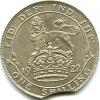
C. Cooke's Farthings to be sold
Rob replied to Emperor Oli's topic in British Coin Related Discussions & Enquiries
Correct, it should get better. Even though I don't collect farthings, I'll still get a couple for posterity to fill gaps where I don't have an example of that type. Get a first class piece and you won't go far wrong. -
I might try to negotiate free postage
-
A tad optimistic 1862 halfpenny
-
Most 20th century currency halfpennies are only worth something if they are in mint condition. If you take these then the value will vary from 20-30p up to about £40 if they are as struck with full lustre. Generally for the above condition, Edward VII are £20-40, George V £15-40, George VI £5-10 and Elizabeth II up to £10. With the exception of 1956 which has 3 rarer varieties being the wide rim obverse which has the I of Gratia pointing to the right of a border dot and I of DEI between 2 dots coupled with the 2 types of reverse and the third type is the narrow rim obverse where the I of GRATIA points to a dot and the reverse has the L of HALF pointing directly to a border tooth. All these three are rare, the wide rim obverse and L pointing between teeth particularly so. Condition would determine the price. There are two scarcer varieties of 1940 and the calm sea 1957 but these are only slightly more valuable than the regular varieties. Almost mint state early 20th century pieces will also have some value. You may find there are proofs from the sets issued in 1937, 1950, 1951 and 1953 if you are lucky. There are proofs for most years from 1926 onwards, but it would be amazing if one of those turned up as all are extremely rare and have always been in collections rather than circulation. Other than this, they are unlikely to have any value to collectors. i.e. pence - if you could find a buyer. There is another thread on this site which has images of 1956 halfpennies.
-
Thanks Geordie. I'm trying not to get a book because I can't afford to collect Romans as well. Once you have a book and can identify coins you are suddenly awash with prospective purchases and we all know what happens when tempted by something attractive.
-
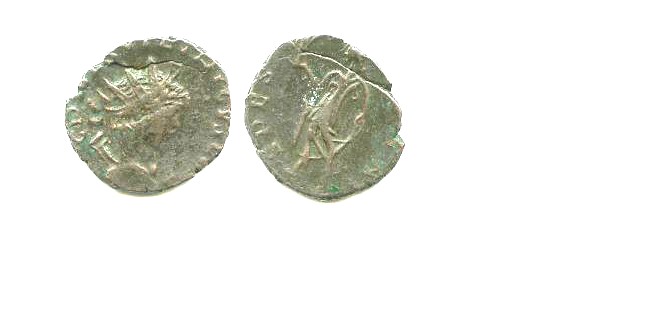
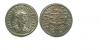
Finally, something dire. Base metal, weighs 1.68g and is 16-18mm wide. It appears to be Tetricvs with Spes holding a something on the reverse. Any info on any of these 4 would be appreciated. Thanks.
-
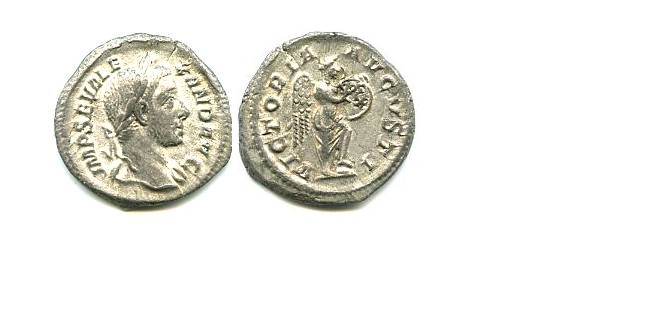
Third is not so good. I think it is a denarius of Severus Alexander weighing 2.98g and approx. 17-18mm diameter.

-
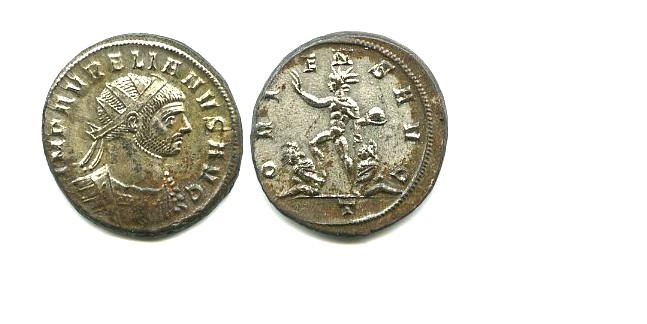
Similar request for the second. I presume is an Aurelian antoninianus with Sol to left between two captives and I think Spink 569. Approx. 20-22mm diameter and weighs 4.80g.
-
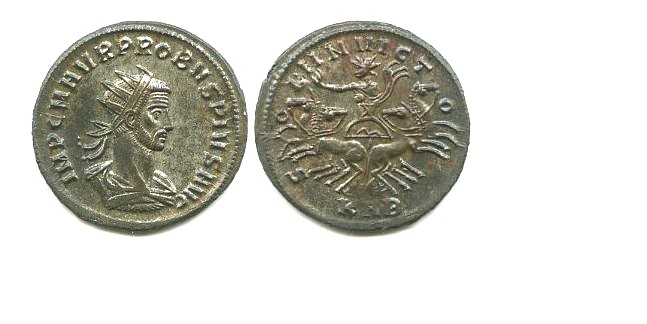
Can anyone add any references and/or provide an alternative id to the following 4 Romans. The first I presume is a Probus antoninianus with SOL INVICTO & Sol driving a 4 horse chariot on the reverse. Approx. 21mm diameter and weighs 3.81g.
-
1856 halfpenny with the 6 struck over a larger underlying 6. Presumably a penny punch 6 although not all 1856 pennies have large digits, my P1511 digits being the same size as the picture

-
OR of GEORGIVS struck over a misplaced O on a 1773 halfpenny

-
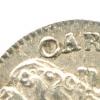
C over another C 120 degrees out in CAROLVS 1680 3d
-
1914 and 1922 seem to be the most difficult years to obtain in top grade. In low grades, there are no rarities. 1919 -1922 are quite difficult in full lustre, frequently they have streaky lustre in unc.
-
In that case Peter, keep your back covered in case you get surprised by 5th column patterns masquerading as currency pieces such as this Peck 606 If you are not careful, you may accidentally acquire one.

-
Another defining feature if present is the edge milling. Again a comparison between an uncirculated currency coin and a proof (both 1887 JH 6d's) shows how much the quality can degenerate. The proof on the right has very sharp milling by comparison.

-
While we are on the subject of proofs, it might be worthwhile to identify a few points which would determine whether a coin is a proof or not. Proofs will usually have a sharp rim/edge angle. Occasionally this is not quite perfect, but almost without exception results in no excess metal to the rims. In the picture the top coin is obviously the proof, the currency piece has excess metal. Both are uncirculated.

-
Yes please.
-
I see the link to another posting on this forum hasn't worked very well. The image I was trying to show was the picture with the 2 1876s. One was the proof and one a currency coin. The sharp angles on the numbers can easily be seen.
-
On a proof, the fields (the empty bits between the design) will be mirror like. The legend will be composed of letters with sharp angles rather than rounded edges like this. The design will often be "frosted" and not reflective at all like the picture below where the one on the left is a proof, the one on the right a currency piece with the same design. The currency piece is prooflike, but not a proof. The best way to interpret the picture is to view it as a reflectivity picture. The dark areas are the most reflective. You will see that the range of reflectivity is much less on the currency piece despite both pieces shown having full lustre. The prooflike nature also shows on the currency piece. A fully lustred coin without prooflike features will be fairly even in terms of reflectivity. Other features are also notable. The rims will usually form a sharp angle with the edge on a proof. If the edge is milled (not in the case of a 1901 penny) the milling will be much sharper, sometimes to the point where it almost cuts your finger) if you grip the edge. I will add, it is something that many people have difficulty identifying because full lustre does not constitute a proof. Post a picture and it will be easier to decide if it is a proof. If it is a proof, don't leave it in plastic as this will cause it to chemically react and also dont touch anything other than the edge with your fingers.

-
Should the 1843 description not read "Good flat flan with high points visible on inspection"?
-
I believe the fakes are thicker than the genuine item. That's only what I've been told though, I've never seen one.