
Rob
-
Posts
12,944 -
Joined
-
Last visited
-
Days Won
372
Content Type
Profiles
Forums
Events
Downloads
Store
Gallery
Articles
Everything posted by Rob
-
What's up with this shilling?
Rob replied to azda's topic in British Coin Related Discussions & Enquiries
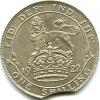
Adjustment marks, flan flaws and die fill. -
1887 double florin proofs
Rob replied to Nick's topic in British Coin Related Discussions & Enquiries
That isn't a proof. The rims are too narrow and it's been polished to ******** -
What's Going On at DNW
Rob replied to DaveG38's topic in British Coin Related Discussions & Enquiries
No idea what they are doing. Didn't get a catalogue, so didn't waste a day looking at the lots one by one. i.e didn't bother bidding. Plenty of other auctioneers that do send out catalogues. -
I think it might also be due to wear in the fixing point for the die. If the die isn't firmly clamped in place then the die will wobble in the locating hole which would open out the hole long term. 5 degrees would be easily achieved and presumably more in the longer term. I think this is why you often see the early Soho pieces with very weak legend suggesting the die has been filled. Highly likely given that swarf would be produced where the die cuts the blank, and if combined with rotational displacement you would rapidly fill the incuse areas of the die i.e the legend and the design. This would be exacerbated the further you are from the centre of the die face because the angular movement is proportionally greater the closer you get to the rim.
-
Not my experience. I have quite often been below my max in the past several years. I concur.
-
Cumberland clark Catalogue
Rob replied to mhcoins's topic in British Coin Related Discussions & Enquiries
not the same coin -
No idea, some sort of token or jetton possibly?
-
I'm surprised they didn't say consult your union rep.
-
I wonder how the mint workers enjoyed themselves.
-
I suspect they are trying to bracket them as 'investment coins' given the way Stanley Gibbons are developing their rare coin indices and pushing coins as an alternative investment. Keeping the prices high would be an integral part of this strategy.
-
You can only do this once or twice because the large libraries will inevitably focus on the same important sales. As a one off event though it is a very sensible way to form the basis of a decent library because adding catalogues piecemeal is quite frankly a pain in the a**e, and relatively very expensive.
-
The easiest and most cost effective way is to buy a complete library (obviously after checking the contents, of course). Doing that enabled me to expand it by about 1500 catalogues, with only 200 duplicates left over. That's cost effective. Still need hundreds of important ones though, and thousands if you include the minor sales,
-
It may predate it. If the wax was left there in 1919 then the cast would show the line. Key will be confirming that the wax is definitely not present in 1916. As the cast is taken from the wax impression, it would be in the Bliss catalogue if deposited at that time. Looking a bit harder, I am inclined to believe that it was deposited in 1919 as I can't see anything on the reverse either by the P or on the leg of the N in Bliss. The obverse wax is in the Hamilton Smith catalogue fortuitously as these images are unusually crisp.
-
Find them and buy them. Sorry, don't have any spares of these.
-
Not the first time coins have been listed without. Seen it on dealer sites too. Personally I like to know as much as possible about a coin's 'collectable' history and I can't see it would do any harm. Perhaps it's just more work than they think it's worth putting in? But it feels like they're missing a trick there. The only people that benefit would appear to be the buyers who end up with a more interesting coin than the competition realised. Most unbusinesslike! . Don't whinge. You might be on the receiving end of some nice info one day.
-
Jon Mann spent some time looking up provenances, but he only had so much time to do it. 300 lots can't be researched thoroughly in a few months.
-
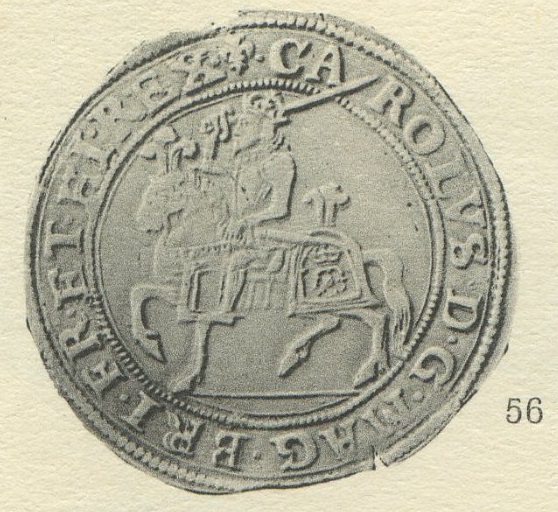
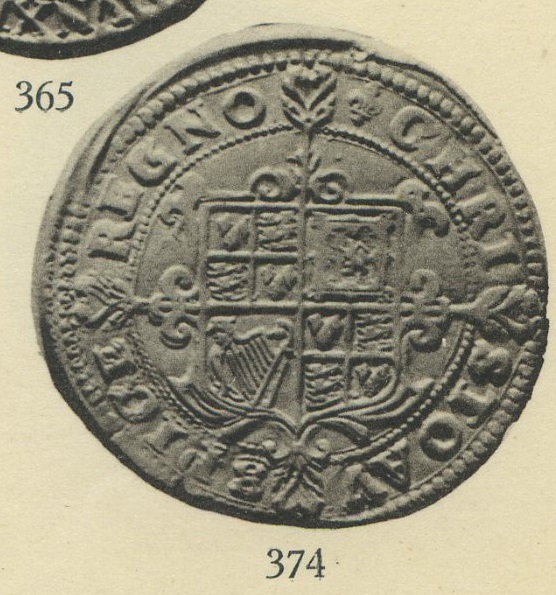
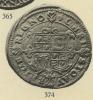
Attached images as follows. The obverse is from Hamilton Smith 1919 where you can see the thin line of wax above the horse's head. This catalogue didn't show the reverses. The reverse is the Wheeler catalogue where you can see the blob by the P at the bottom. I can't show the obverse as it is too close to the spine - i.e the catalogue would disintegrate. I can't see any wax on the Bliss images, but they aren't the best.
-
I haven't got any evidence for the use of wax impressions post-WW2. There were few things illustrated during the war making an end date difficult to define. It is likely that the wax is restricted to the period 1890-1945 for sales, but I think it was used in the immediate post-war period for BNJ illustrations. My Ed.IV heavy halfpenny has a lot of wax on it and the only place I am aware it is illustrated is in Blunt and Whitton's article in vol.25 (1945-8). Not everything with wax was illustrated in a catalogue. The Edward the Elder penny I posted on p.359 of this thread has a small spot of wax on the reverse which it transpires was from when the BM took a cast for their records. Lockett bought the coin at the Vatican Hoard sale in 1929, but as it is unique, the BM didn't have an example hence the cast. You can narrow the potential sales from the colour of the wax too.
-
Actually, the wax could be either from the above or also Hamilton Smith (1919) or Wheeler (1930), both of which were given in the Slaney catalogue
-
Only Bliss (which is where the wax will be from), but the above provenance is given in the catalogue. Montagu was the first illustrated sale in 1895-7.
-
It was illustrated in the Bliss sale lot 368, 22/3/1916 bt Spink. From there it trundles back to Trattle 1832 lot 640 via Durrant 589 (1847), Martin 263 (1858), Bergne 669 (1873), Rostron 247 (1892) and Clark 218 (1898) Super provenance.
-
Same from me. Haven't seen you for a bit?
-
It's a mule between a left facing bust die and a right facing die. What's wrong with that? 7 or $800 all in for a coin worth a fiver seems a heavy price to pay for relying on the TPG. Only question is, will it be returned as a wrong un? Check the September catalogue to find out.
-
Doubt it. They didn't do piedforts until they started striking in silver. It should be just a regular proof
-
We have more progress. My son has configured something so that the DNS? is now pointing to BT and Google whatever that means. Something about the BT IP blocking some sites, which in this case he thought it might be conflicting with 'The Goldbergs' - something about stopping piracy, though why anyone would want to pirate that or worse still watch it is beyond me. Good news is that I can now log in and place bids. Thanks to all for putting up with my stupid questions.