Tudor Coinage
I am very pleased to have been given permission to publish this very good 12 part history of British Coinage, written by Ken Elks. It contains a wealth of information on all era's of British coinage from the first Celtic coins until decimalisation.
Part 1, Celtic Coinage.
Part 2, Roman Coinage.
Part 3, Anglo Saxon Coinage.
Part 4, Norman and early English coins.
Part 5, Tudor coins
Part 6, Stuarts and the Commonwealth.
Part 7, Early Milled coins.
Part 8, Milled Coins 1662 - 1816.
Part 9, Provincial token coinage.
Part 10, The Great Re-Coinage.
Part 11, Decimal Coins.
Part 12, Scottish Coins.
Coinage of Great Britain. Celtic to Decimalisation, by Ken Elks.
Part 5, Tudor Coins.
History
During the whole of the medieval period the economy of England had been growing steadily. Gradually increasing trade with the Continent and the growth of towns led to a need for a more extensive coinage, which included the introduction of gold denominations. The prosperity of England was mainly based on agriculture and animal husbandry, accompanied by increasing industry, such as wool textiles, and commerce. This received a setback in the fourteenth century with the advent of the Black Death, which caused a sharp decline in the population to half of what it had been previously. More importantly it seemed to have a disproportionate effect on children and males in particular, with disastrous consequences for the economy. Nevertheless, by the beginning of the fifteenth century the abatement in the incidence of plague brought about a recovery. The residual effect was mainly in higher wages and price levels, which themselves stimulated the demand for money.
This recovery did not last long into the fifteenth century and there is strong evidence of a contraction in the economy. Trade with the Continent fell dramatically as a result of the successive wars waged by English kings aimed at extending or defending their possessions in France and in quarrels with Spain and the Hanseatic League. All this was combined with a continued fall in the population that sent the economy into a severe recession. The Wars of the Roses and internal strife, coupled with periodic outbreaks of plague and other diseases, had a similar effect.
By the accession of the first of the Tudor monarchs, Henry VII in 1485, the economy was in ruins. Although it is possible that some kind of recovery had already started, the policies of Henry proved extremely effective in restoring the wealth of the nation.
His first step was to effect a reconciliation between the Lancastrians and the Yorkists by marrying Elizabeth, the daughter of Edward IV. The emblem he adopted, the Tudor rose, combined both the red rose of Lancaster with the white rose of York. Nevertheless his right to be king was extremely slim and throughout his reign there were numerous plots to supplant him. The most serious of these was that of Perkin Warbeck, who claimed to be the son of Edward IV and was supported by both France and the Netherlands. It was not until near the end of his reign that his throne was secure from internal threats.
A brief involvement at the outset in a war between Spain and France convinced Henry that there was a better way for an impoverished country to conduct its affairs and he quickly made peace with France. In 1496 he finally persuaded the Netherlands to abandon the cause of Warbeck, whose final defeat quickly followed, and entered into a treaty, the Intercursus Magnus, which not only brought peace but also increased trade between the two countries.
Scotland, too, had supported Warbeck and it was not until 1499 that a peace treaty was signed, followed by the marriage of Henry's daughter, Margaret, to the Scottish king, James IV. Such policies of Henry VII not only kept England out of foreign wars but also, through a series of commercial treaties, enriched the nation.
Domestically Henry was at pains to secure as much wealth as possible to free himself from dependence on Parliament. This was accomplished by a prudent management of finances, greater efficiency in administration and increasing revenues from, for example, customs duties by encouraging exports. This was augmented by a ruthless application of fines and levies. When he died in 1509 he left to his son, Henry VIII, a secure realm and a large fortune.
Unfortunately, Henry VIII, notorious for his several wives and the break with the catholic church which led to the Reformation, deserved greater opprobrium for the ruin that he brought to the kingdom, which, among other things, necessitated the first debasement of the English coinage.
Almost immediately Henry VIII began to make war on France as an ally of Spain. An expedition that landed near Bayonne ended in failure and the English navy was disastrously defeated at Brest in April 1513. Undeterred, Henry invaded northern France with a large army, capturing Tournai. Meanwhile a Scottish invasion as an ally of France was defeated at Flodden, resulting in the death of the Scottish King, James IV. The minority of his successor, James V, whose mother and regent was Henry's sister, Margaret ensured peace for a while. A treaty with France followed in 1514 but a new French king, Francis I, brought about a revival in French martial prowess and aroused Henry's jealousy by his successes.
England, however, benefited initially from a new rivalry between Spain and France, both of whom wanted an alliance to offset the power of the other. In 1520 there came the famous meeting between France and England in the pageant known as the Field of the Cloth of Gold, despite which England became a firm ally of Spain and in 1522 joined in a war against France. This culminated in a resounding victory for Spanish arms in 1525, to which the England involvement was peripheral. In an effort to curb Spain's growing power, England blundered into allying itself with France, both countries declaring war on Spain in 1528. The Peace of Cambrai the following year left England isolated once again.
From 1527 Henry VIII had been seeking a divorce from his wife, Catherine of Aragon. This partly contributed to the rift with Spain and resulted from attempts to incur favour with the Pope by supporting him in his struggles with the Spanish Emperor, Charles V. By 1530 Henry felt he had waited long enough and began the process that led to the final break with Rome. The pregnancy of his mistress, Anne Boleyn, added impetus and by 1534 the transfer of papal power to the king was complete. The dissolution of the monasteries quickly followed.
The Crown was greatly enriched by the proceeds from confiscation of Church assets as well as, for eight years, the prudent administration of Thomas Cromwell, but five years of upheaval took their toll. With the downfall of Cromwell, Henry took the reigns of government on himself and almost immediately got embroiled in Continental politics again. A new war with Scotland began in 1542 and ended with a rout of a Scottish army that led to the death of their king but left the pro-French faction in control. Any gain was temporary, as Henry's bungled attempts at diplomacy afterwards revived Scottish nationalism to the extent that hostilities again broke out and continued virtually to the end of the reign.
Mistakenly thinking that the northern crisis had been resolved, Henry declared war on France in alliance with Spain. Having captured Boulogne, the English advance petered out and after three years and the collapse of the alliance Henry had to make peace. The war cost over £2 million, a horrendously large sum at the time, and for little gain. The escalation of taxes to pay for it led to rapid inflation. To pay for this, large amounts of crown land were sold, and loans incurred abroad at exorbitant rates of interest and in 1544 the coinage was debased. The effect of the final years of Henry VIII was to destroy the English economy and undermine its prosperity for several decades.
The brief reign (1547-1553) of the boy king, Edward VI, was marred by a renewed war with Scotland and large scale unrest in England, notably Ket's rebellion of 1549. The faction led by the Earl of Northumberland following the ousting of the Lord protector, the Earl of Somerset began some reform of government without success, but when Edward died prematurely, Northumberland's attempt to install Lady Jane Grey on the throne ended in failure and his (and Lady Jane's) execution. The equally brief reign of Edward's sister Mary, known as "Bloody Mary" for her persecution of Protestants, was noted for its futile attempt to restore the Catholic faith and a war which led to the loss of Calais, the final English possession in France. In 1554 she married Philip II of Spain, a move which proved equally unpopular with her people.
When Mary died of cancer in 1558, her sister Elizabeth, daughter of Anne Boleyn and Henry VIII's only surviving child, became queen. Her reign ushered in a new era of prosperity and greatness that laid the foundation which finally established England on the world stage.
For the first years of her reign, the country was at peace while Elizabeth struggled to establish herself, treating the Catholics with moderation, which gradually won them over. The intransigence of the Puritans compelled her to take action against them and forced them into a degree of conformity, but in 1567 Mary, Queen of Scots, herself a great granddaughter of Henry VII, was driven from Scotland and became the focus of Catholic plots to supplant Elizabeth. Although imprisoned by Elizabeth the thoughtless intrigues of Mary and her supporters eventually led to her execution.
The central themes of Elizabeth's policies were good government at home and sound finances. Throughout she maintained an uneasy alliance with Philip II of Spain that served both rulers well, but the strains proved too much. The main cause of the break was growing rivalry between Spain and England in the newly discovered Americas, aggravated by Spanish involvement in the many plots against the Queen and their support of Mary, Queen of Scots, and the fomentation of rebellion in Scotland against the Anglophile regents. Successive crises and minor skirmishes brought open conflict with Spain in 1585 which was to last to the end of Elizabeth's reign. The greatest danger was the Spanish Armada of 1588, which was to link up with Spanish forces in the Netherlands and invade England. Although this was defeated there were several more attempts afterwards which met with a similar lack of success. As a prelude, Mary, Queen of Scots, was executed in 1587 for approving yet another plot against Elizabeth that had already been betrayed to Walsingham, the head of Elizabeth's secret service.
With some startling successes and quite a few failures the war dragged on and was further complicated in 1595 by a rebellion in Ireland which embroiled Elizabeth's armies and became a constant drag on the royal purse until finally suppressed in 1600. Yet at the same time, English merchants began to open up new trade routes, colonies were established in America and, for the most part, the English navy began to rule the sea lanes.
Just before Elizabeth died in 1603, she named the Scottish King, James VI, son of Mary, Queen of Scots, as her successor. By that time, the war with Spain had virtually faded away after the death of Philip in 1598.
The coinage
The early coinage of Henry VII continued that of previous reigns, consisting of the groat, half-groat, penny and halfpenny in silver with their traditional facing portraits. In gold, there was the ryal of ten shillings, the angel valued at six shillings and eight pence and a half angel of three shillings and fourpence. All the gold denominations are scarce.
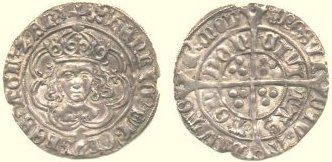
Henry VII early groat, continuing the designs of previous reigns 1485-1505
Tower mint - mintmark: Crowned leopard's head
In 1489 Henry replaced the ryal with the sovereign, valued at 20 shillings, a large gold coin based on the real d'or of the Netherlands. In silver he introduced a new coin the shilling or testoon, probably in 1505.
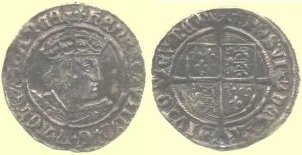
The major innovation of his reign was the introduction in 1502 of a realistic profile portrait of the king on the obverse of the groat and half-groat and also the new testoon when that was first minted. This replaced the stylised facing portrait of previous reigns and was the work of Alexander Brugsal, a German appointed as engraver to the mint in 1494. The obverse legend was expanded to give the king's name as HENRIC VII, a practice continued by his successors. The design of the penny was also changed, to show the king seated on a throne, from which it became known as the "sovereign penny".
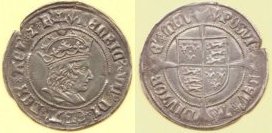
Henry VII silver groat with lifelike profile portrait
It was first used on trial pieces in 1502 and adopted in 1505
The first issues of Henry VIII were practically identical to those of his father but reading HENRIC VIII, with little change until 1525. However, in 1526 the rising value of gold led to a revaluation of the gold coins so that the sovereign became worth twenty-two shillings. Other gold coins showed similar increases. In order to preserve the standard 6 shillings and 8 pence unit of accountancy a new gold coin with that value, the George noble which showed St George spearing a dragon, was introduced to replace the angel, now worth 7s. 6d. Neither that coin, nor two others, the half-George of 3s 4d and the rose crown of 4s 6d, proved to be popular and were quickly discontinued. They were replaced by a gold crown of five shillings and half crown of 2s 6d.
On the silver groat and half groat from 1526 onwards a new portrait was introduced of the young Henry VIII. In his third coinage 1544-1547, the state of the nation's finances necessitated some drastic changes. The gold coinage reverted to the original values but was reduced in weight to compensate. Sovereigns of twenty shillings, half-sovereigns, angels (though of the same value as the George noble at 6s 8d the design went back to the former standing figure of St Michael killing a dragon), crown, half angel and half crown. The testoon or shilling made a reappearance, now with a bearded facing portrait of the king, which was also used on the groat and half groat. These silver issues were heavily debased, and as a result the king was referred to as "Old Copper Nose", because the king's nose turned copper-coloured when the coin began to wear.
The earliest coins of Edward VI were posthumous issues for his father, continued until 1550 together with base silver coins for Edward himself. Among these base silver coins were shillings which were the first English coins to bear a date, shown in Roman numerals, MDXLIX for 1549, MDL for 1550 and MDLI for 1551. During 1551, as part of Northumberland's reforms, these were replaced by a coinage of good quality silver, which included two new denominations, the sixpence and the threepence. All three coins bore value marks in Latin numerals, XII, VI and III pence, the first ever used on English coins.
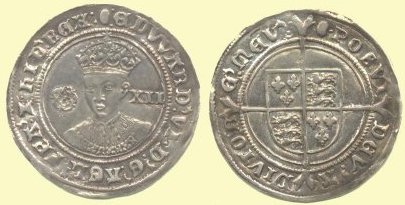
Edward VI fine silver shilling 1551-1553
The sixpence and threepence were of a similar design
As part of the reforms there was a gold sovereign valued at thirty shillings with obverse of a seated facing figure of the king enthroned, but this was soon replaced with a lighter coin of twenty shillings depicting a three-quarter length bust of the king. Other gold denominations included the half sovereign, initially fifteen shillings then a ten shilling coin similar to the sovereign, the crown and half crown, both with proportionate values. The fine silver issues from 1551 onwards included crowns and half crowns with an obverse showing the king on horseback, a design that continued until the Commonwealth.
The coinage of Mary divides naturally into two parts, first as queen in her own right and then those coins issued after her marriage in 1554 to Philip of Spain. Among the early issues was a fine gold sovereign with a high degree of workmanship valued at thirty shillings together a ryal, by that time something of an anachronism, angels and half-angels. In silver there were no crowns, half crowns or shillings but plentiful quantities of groats, rare half groats and a few pennies. The shilling and sixpence were reintroduced after 1554 for the coinage bearing facing portraits of Philip and Mary.
*Image* Mary groat from the period prior to her marriage, 1553-1554
Tower mint - mintmark: pomegranate
After her succession, Elizabeth took the courageous and costly step of recalling all the base silver coins which were still in circulation and replacing them with coins of a high silver content. As a first step some of the base silver coins were devalued and countermarked. Coins of Edward VI exhibiting a greyhound countermark were part of this process.
The long reign of Elizabeth brought many changes to the coinage and a wide range of denominations. It also saw the tentative beginnings of the change to a milled coinage. The gold denominations consisted of the fine sovereign of thirty shillings, the pound, half pound, crown and half crown of twenty, ten, five shillings and 2s 6d respectively. Occupying a slightly anomalous position were the series of angels, half angels and quarter angels, all with the same values as the half pound, crown and half crown. The initial series of silver coins included the shilling (now firmly established as a major denomination), groat, half groat and penny.
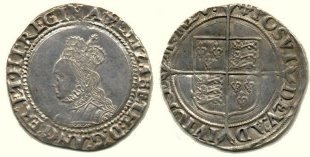
Elizabeth I shilling of her second coinage1560-61 mintmark: crosslet
In her third coinage, from 1561 onwards, these were supplemented by the reintroduced sixpence, threepence and two new and short-lived denominations, the three half pence and three farthings, all of which bear the date of mintage above the shield on the reverse.
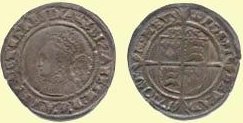
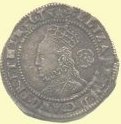
Elizabeth I sixpence dated 1565
Halfpence were struck towards the end of the reign. During the last two years two beautiful coins, silver crowns and half crowns, were issued bearing a half-length bust of the queen holding an orb and sceptre. These bear the dates in the form of a 1 or a 2, which stood for 1601 and 1602.
Appendix 1
Tudor monarchs
Henry VII 1485-1509
Henry VIII 1509-1547
Edward VI 1547-1553
Mary 1553-1558
Elizabeth I 1558-1603