Anglo-Saxon Coinage in Britain
I am very pleased to have been given permission to publish this very good 12 part history of British Coinage, written by Ken Elks. It contains a wealth of information on all era's of British coinage from the first Celtic coins until decimalisation.
Part 1, Celtic Coinage.
Part 2, Roman Coinage.
Part 3, Anglo Saxon Coinage.
Part 4, Norman and early English coins.
Part 5, Tudor coins
Part 6, Stuarts and the Commonwealth.
Part 7, Early Milled coins.
Part 8, Milled Coins 1662 - 1816.
Part 9, Provincial token coinage.
Part 10, The Great Re-Coinage.
Part 11, Decimal Coins.
Part 12, Scottish Coins.
Coinage of Great Britain. Celtic to Decimalisation, by Ken Elks.
Part 3, Anglo Saxon Coinage.
Anglo-Saxon History
Unlike the Roman conquest of Britain, which was completed, for most practical purposes, within 50 years, the Anglo-Saxon conquest took much longer and was confined only to England. Assuming that the traditional date for the arrival of Hengist and Horsa is approximately correct, A.D. 455, it was to be another 150 years before the mainly Celtic Romano-British population was driven into Wales and the extreme south-west.
The chief historical source for the initial period is a British monk, Gildas Bandonicus, who lived in the sixth Century, whose narrative formed the basis of that part of a history covering the same period written by a Saxon monk, Bede, completed in A.D. 731. Later there is the Anglo-Saxon Chronicle, composed in the time of Alfred the Great (A.D. 871-899).
According to Gildas, British resistance was led by a man called Ambrosius Aurelianus, culminating in the battle of Mons Badon (Badon Hill), "forty-four years and one month" after the arrival of the Saxons. In this battle the British were decisively victorious. The Battle of Badon Hill therefore took place circa A.D. 500, which Gildas mentions as being the year of his birth. The respite thus afforded to the Britons nevertheless left the invading Jutes in control of Sussex and Kent, and the Anglo-Saxons with the whole of East Anglia and part of Yorkshire. To this must be added the West Saxons in Hampshire who founded a kingdom there under Cerdic circa A.D. 520. With this exception, it was to be 50 years before the Anglo-Saxons began further major advances.
In the intervening years the Britons exhausted themselves with civil war, internal disputes and general unrest, which was the inspiration behind Gildas and his De Excidio Britanniae (The Ruin of Britain). There was a mass migration of Britons to Brittany in France. Relentlessly fed by fresh arrivals from Germany the Anglo-Saxons steadily reinforced their grip. In the middle of the 6th Century A.D., the settlements in Yorkshire had expanded into Northumbria, resulting in two kingdoms, those of Deira in North Yorkshire and Berenicia in Northumberland and Durham. The Angles in the north of East Anglia had begun to move westwards as far as the Trent valley in the Midlands. By the end of the century the kingdoms of Berenicia and Deira had been combined to form the kingdom of Northumbria under Aethelfrid and expanded by his successor Edwin. The army of the Britons was crushingly defeated by Aethelfrid at Chester circa A.D. 615. The embryonic kingdom of Mercia in the Midlands was established by the last decade of the 6th Century. The next hundred years were to see a prolonged conflict between these two new powers.
The kingdom of Kent, founded by Oisc (Aesc) son of Hengist circa A.D. 488, had prospered in the years of peace following Badon Hill. By the end of the 6th Century it was ruled by Aethelberht, a descendant of Oisc, who reigned from A.D. 560 to 616. It was to Aethelberht's court that Pope Gregory dispatched the famous mission led by Augustine, to convert the heathen English to Christianity. The foundation for this had already been laid by Aethelberht's wife, Queen Bertha, a princess of the Merovingian royal house in France, who was already a Christian. Mass baptisms of the populace took place on Christmas day A.D. 597. From this beginning Christianity was to spread throughout England, first to Northumberland and then, gradually to all the other kingdoms.
The first major campaign against the Britons was in A.D. 577, led by Cealwin, king of Wessex, whose successes led to the annexation of Wiltshire, Gloucestershire and Somerset and then Oxfordshire. This expansion of Wessex ended abruptly when they started squabbling among themselves, which resulted in Cealwin being killed and replaced by his nephew, Ceol. It also brought them up against the borders of Mercia, as a result of which they lost some of their newly gained territory after a battle fought at Cirencester.
Following this success, the Mercian king Penda made an alliance with a Welsh prince, Cadwallon, and together they attacked Edwin of Northumberland. In a battle fought near Doncaster, in A.D. 633, Edwin was killed. The success was short-lived. In his turn, Oswald, a son of Aethelfrid, defeated and killed Cadwallon and drove off the Mercians. In less than a decade Penda again waged war against Northumbria and Oswald was killed. For the rest of his reign Penda mercilessly expanded Mercian territory at the expense of all the neighbouring kingdoms. Oswald's brother Oswy was left with just Berenicia of the former kingdom. In A.D. 655, Penda decided to make an end of Oswy and assembled a great army. In desperation Oswy attacked and won an overwhelming victory, killing Penda and leaving Northumbria as the paramount kingdom in all England. However, three years later Wulfhere, son of Penda managed to regain all of Mercia's lost territory and extended his rule as far as Kent. Even Wessex was forced to acknowledge his hegemony.
But, as before, Wulfhere risked everything by deciding to deal a decisive blow against Northumbria but was defeated and presumably killed. Despite this setback, Mercian kings continued to dominate for most of the 8th Century. The most powerful, Offa, who seized the throne in A.D. 757 and reigned until 796, was the acknowledged ruler of all England, with all the other kingdoms subservient to his wishes, but the end of his reign marked the beginning of the end of Mercian supremacy. Shortly before his death came the first Viking attack, A.D. 793, when the monastery of Lindisfarne was raided and plundered. Offa's most last achievement was Offa's Dyke, a 70 mile long defensive wall and ditch marking the boundary between his lands and those of the Welsh.
The oppressive reigns of Offa and his successor, Coenwulf, eventually led to the downfall of Mercia and the rise of Wessex, heralded as a saviour under their king Egbert (Ecgberht). In the confused aftermath of Coenwulf's death Egbert seized his chance and in A.D. 825 defeated the Mercians in a battle at Ellendun, near Swindon which precipitated the swift collapse of Mercian power. Other kingdoms unanimously turned to Egbert as a deliverer and protector against further Mercian aggression. In A.D. 828, Egbert was recognised as the overlord of all the English kings.
In the meantime, Viking raids grew and, like the Anglo-Saxons before them, was followed by large-scale migration from Norway and Denmark and settlement along the east coast. The major task of the kings of Wessex during the remainder of the 9th Century was stemming the Viking advance, with varying degrees of success. Not until Alfred the Great defeated the Danes at Edington in A.D.878 was peace restored and in the Treaty of Wedmore, England was divided into two parts. Wessex controlled part of the Midlands and the whole of the south (excluding Cornwall, still held by the Britons), while the Danes were firmly established in East Anglia and the north, called the Danelaw. Despite this Alfred captured London from the Danes in A.D. 886 and his successor, Edward the Elder recaptured Essex in A.D. 913. Edward's son Athelstan annexed Northumbria, forced the kings of Wales to submit and, at the battle of Brunanburh in A.D. 937, defeated an alliance of the Scots, Danes and Vikings to become King of All England.
The end of the 10th Century was marked by renewed Viking and Danish raids on England with extensive settlements in the north-east, Yorkshire, Lincolnshire and Norfolk. Aethelred II (978-1016), known colloquially as the Unready (but in reality "redeless" meaning uncounselled), embarked on a policy of buying off the Danes with huge payments in silver, known as the Danegeld. The first attack cost 10,000 pounds of silver, the next 36,000 and finally 48,000. This policy proved unsuccessful when the Danish leader Sweyn invaded England and Aethelred was forced to flee to Normandy. On the death of Sweyn, Aethelred returned but the Danish attack was renewed by Cnut (Canute). After the death of Aethelred his son, Edmund Ironside divided the kingdom between himself and Cnut, whereupon Edmund was almost immediately assasinated and Cnut became sole ruler, marrying Aethelred's widow, Emma of Normandy, to reinforce his claim. He divided England into four earldoms.
Following the brief reigns of Harold I and Harthacnut (Hardicanute), Aethelred's son Edward the Confessor became king. Meanwhile, Godwin, the Earl of Wessex, who had been exiled, returned to England and was succeeded by his son Harold in 1053. Just over 10 years later Harold was shipwrecked in Normandy and is alleged to have sworn a solemn oath to support William, Duke of Normandy, in his claim to the English throne after the death of the childless Edward. When Edward died in 1066, Harold instead had himself proclaimed king, but immediately had to rush to the north to meet an invasion led by his brother Tostig and Harold Hardrada of Norway. They met in battle at Stamford Bridge in Yorkshire and the English army won a crushing victory. Before they had time to celebrate, news came that William had landed on the south coast. The army was forced to march immediately southwards, to meet the Normans at Senlac Hill, above Hastings. After a long, hard-fought, battle, the Normans prevailed and Harold was killed. Duke William became king of England, forever afterwards known as William the Conqueror.
The Coinage
The first Anglo-Saxon coins were gold thrysmas, copied from Roman bronze coins. These were possibly only for trade with the continent. They rapidly became debased and were eventually discontinued. During the 5th century some Byzantine gold coins circulated in Britain, together with coins of the Merovingian kings from Theudebert I (A.D. 533-548) onwards but may not have served as currency in the true sense. The first real coinage was the sceatta (pronounced "shee-atta"), a small silver coin first mentioned in the laws of Aethelberht, king of Kent, circa A.D. 600, which also equated the gold shilling, the Byzantine and Merovingian tremissis or one-third of a gold solidus, with a value of 20 sceattas. This value did, however, differ in other parts of the country and appears to have changed over time.

East Anglian silver sceatta circa AD 680-700
The sceatta was produced in a wide variety of types and styles, utilising a combination of abstract designs, some of which appear to be derived from Roman models, others of a purely Germanic inspiration, and were the only unit of currency for over a century and a half. In the latter part of the 8th Century they were only minted in Northumbria, and by the Archbishops of York. By the beginning of the 9th Century, during the long reign of Eanred, they had been replaced by the copper styca, a greatly debased coin of a similar size which lasted for almost another hundred years.
The sceatta was produced in a wide variety of types and styles, utilising a combination of abstract designs, some of which appear to be derived from Roman models, others of a purely Germanic inspiration, and were the only unit of currency for over a century and a half. In the latter part of the 8th Century they were only minted in Northumbria, and by the Archbishops of York. By the beginning of the 9th Century, during the long reign of Eanred, they had been replaced by the copper styca, a greatly debased coin of a similar size which lasted for almost another hundred years.
In the south, the sceatta gave way to the silver penny, introduced by the transitory king of Kent, Heaberht, circa A.D. 764, who appears to have owed his elevation to Offa of Mercia. The penny was based on a Frankish coin introduced about ten years earlier, and was larger and thinner than the sceatta, though weighing approximately the same. It was the only denomination produced until the reign of Edward I, some 500 years later. This was only possible because the main economy was based on barter and not on coins, especially since the penny represented a huge sum of money to the ordinary peasant. On the obverse it bore the king's name and later his effigy, and on the reverse the name of the moneyer. The first pennies were minted at Canterbury, the moneyer being Eoba, who also worked for Ecgberht (Egbert), the next king, together with two other moneyers, who sign themselves Babba and Udd.
The new denomination was taken up by Offa, who produced the first English coins with a royal portrait. Others were minted by the Archbishops of Canterbury, the Kings of East Anglia from Aethelberht Lul onwards and by the kings of Wessex. During the Viking invasion, A.D. 878-964, Viking settlers produced pennies imitating English coins and for their rulers in their own right. The silver penny continued to be minted by the English kings right up to the Norman Conquest and beyond.
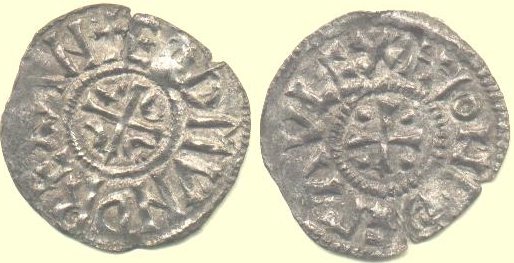
*Image* Eadmund, King of East Anglia AD 855 - 869
Silver penny

Vikings, Siefred Cnut AD 297
Silver penny - "CUNNETTI" type
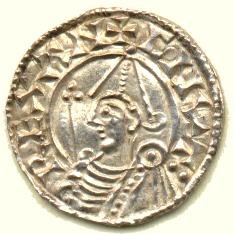
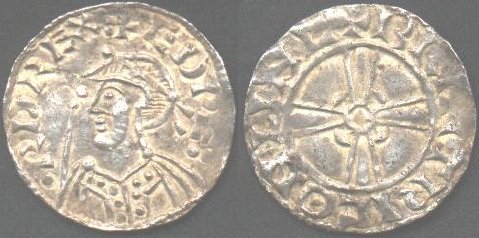
As a result of the Danegeld, the most commonly encountered Anglo Saxon pennies are the coins of Aethelred II and Cnut, during whose reigns a large number of mints were in operation throughout the country.
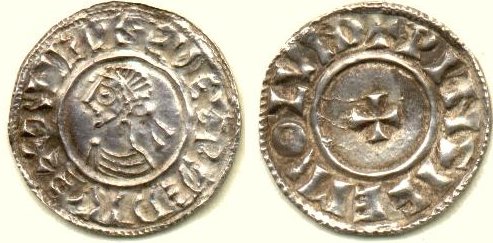
*Image* Aethelred II, King of England AD 978-1016
Silver penny minted in London
Moneyer: Punsige
*Image* Cnut (Canute), King of England AD 1016-1035
Silver penny minted in London
Moneyer: Liofstan

Harold I, King of England, AD 1035-1040
Silver penny minted in Bristol
Moneyer: Leofpine
Kings, Archbishops and other rulers who issued coins
Kings of Northumbria (silver sceattas and copper stycas only)
Eadberht (737-756)
Alchred (765-774)
Aethelred I (First reign 774-778)
Aelfwald ((778-788)
Aethelred I (Second reign 789-794)
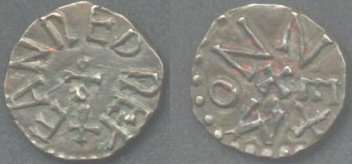
Eanred (c. 810-840) - see Photo
Aethelred II (First reign 840-844)
Redwulf (844)
Aethelred II (Second reign 844-848)
Osberht (848-867)
Archbishops of York (silver sceattas and copper stycas only)
Ecgberht (732-766)
Eanbald II (796-830)
Wigmund (837-854)
Wulfhere (854-900)
The following issued silver pennies only (except where stated)
Kings of Kent
Heaberht (c. 764)
Ecgbehrt (c.765-780)
Eadberht Praen (797-798)
Cuthred (789-807)
Baldred (c. 823-825)
Archbishops of Canterbury
Jaenberht (766-792)
Aethelheard (793-805)
Wulfred (805-832)
Ceolnoth (833-870)
Aethelred (870-889)
Plegmund (890-914)
Kings of Mercia
Offa (757-796) (but coins from circa 770 onwards)
Cynethryth (Queen, wife of Offa)
Coenwulf (796-821)
Ceolwulf I (821-823)
Beornwulf (823-825)
Ludica (825-827)
Wiglaf (827-840)
Berhtwulf (840-852)
Burgred (852-874)
Ceolwulf II (874-877)
Kings of East Anglia
Beonna (c. 758) (sceattas only)
Aethelberht Lul (circa 792-794)
Eadwald (c. 796)
Aethelstan I (c. 850)
Aethelweard (c. 850)
Eadmund (855-870)
Kings of Wessex
Beorhtric (786-802)
Ecgberht (802-839)
Aethelwulf (839-858)
Aethelberht (858-866)
Aethelred I (865-871)
Alfred the Great (871-899)
Edward the Elder (899-924)
Vikings
Copies of coins of Alfred the Great
Minted in East Anglia
Aethelred (c. 870)
Aethelstan II Guthrum (878-890)
Oswald (circa 890? - known only from coins)
Alfdene (circa 900)
St. Eadmund (memorial coinage)
St. Martin of Lincoln (c. 925)
Minted in York
Siefred Cnut (c. 897)
Earl Sihtric (date unknown)
Regnald (919-921)
Sihtric I (921-927)
Anlaf Guthfrithsson (939-941)
Anlaf Sihtricsson (927, 941-944 and 948-952)
Regnald II Guthfrithsson (941-943)
Sihtric II Sihtricsson (942-943)
Eric Bloodaxe (948 and 952-954)
Kings of All England
Aethelstan (924-939)
Eadmund (939-946)
Eadred 946-955)
Eadwig (955-959)
Eadgar (959-975)
Edward the Martyr (975-978)
Aethelred II (978-1016)
Cnut (1016-1035)
Harold I (1035-1040)
Harthacnut (1035-1042)
Edward the Confessor (1042-1066)
Harold II (1066)