

Geoff T
-
Posts
662 -
Joined
-
Last visited
Content Type
Profiles
Forums
Events
Downloads
Store
Gallery
Articles
Posts posted by Geoff T
-
-
hi there. how much would this halfcrown cost?
I think you deserve a serious reply on this one, especially as I see you're a starter member. Am I right in saying you're looking to buy one, rather than asking for the going rate for one you already have? In the latter case a photo would be useful. If the former, then everything is going to depend on the condition. You can pick up a decent one in Fine for under £100, but with coins like this the hike in price as the grading gets higher can be quite a huge leap.
The 1837 half crown is regarded as rare because its official mintage figure was only around 150,000. That's less than the 1905 (160,008). However, given that lower grade 1837s are quite easy to come by, I suspect that a substantial number might well have been struck in 1838 using 1837 dies - particuarly given the change of reign/design/dies - but not included in the mintage figures for 1837. Conversely, I suspect that the rarity of the 1835 is because the mintage figures for that year include many struck from 1834 dies - and 1834 is very common.
Geoff
-
ESC is a good start, but Davies is more detailed for the post-1816 stuff, although his written Englisn is at times a little strange.
G
You mean he uses hs where he should be using ns.


You mean you don't understand simple Englisn, Rob?

Englisn is a recorded variety, known to have been occasioned by a tired typesetter at the end of a hard day


-
I've the same first three as RobJ, which have been great for the beginner I am. Any recommendations on a good book for silver half crowns?
ESC is a good start, but Davies is more detailed for the post-1816 stuff, although his written Englisn is at times a little strange.
G
-
The Latin professor's class was conjugating verbs and it got to be Julius's turn. He had not been paying close attention. He turned to the student beside him and asked, "What's the verb?"
She replied, "Damn if I know."
So our hero sat up and conjugated:
Damifino, damifinas, damifinat.
Damifinamus, damifinatis, damifinant.
My Latin teacher, who doubled as a certified sadist, had a novel way of reminding those who forgot the difference between the active and the passive voice. He'd borrow a gym shoe from the lad with the largest feet in the class and ask the forgetful one to bend over. "Mr M***** slippers X - active", followed by a whack. Another whack and "X is slippered by Mr M***** - passive". That was one of his milder tortures. The amazing thing is that we all took it as read that teachers were allowed to do things like that. It sounds like Dotheboys Hall in the 19th century, but it was actually a grammar school in the 1960s. O tempora, o mores!
But I thought it was an irregular verb like fero, ferre, tuli, latum? Damifino, Ihaven'taclue, Don'taskme, Whydon'tyouGoogle
-
For reasons lost to the mists of time, we used to eat Polo mints in 5th form maths lessons. A packet of Polos cost 4d, which as of today was redefined as 1.5p. I realised that three packets, which formerly cost a shilling, would now cost 4.5p - a saving of a whole new halfpenny. So reader, I bought them. Thus on 15 February 1971, with a clear eye for a bargain, I made my first fully decimal purchase and saw those funny new bronze coins at first hand. Life-changing, when you come to think of it.
Can anyone else d'un certain age remember their experiences of D-Day?
Geoff
-
Hi,
My first post so please be gentle.
I only just started collecting coins relating from a small collection received from an elderly aunt (Passed away). According to my aunt, everything was valuable and the many collector coins I have (Churchhill etc.,) I know the true value, but this one coin puzzled me which was amongst the soverigns and other silver coins.. It would appear from my research to be Queen Anne and in too good a condition to be that old.

IS this a fake and how may I tell
Thank you in advance
Peter
(appera not to have loaded the picture - hope that this sorts it out)
This isn't Anne, for a start - it's Elizabeth I!
-
Hi,
This is my last acquisition and I am very happy with it. Sorry for the picture, but the coin is so small that I struggled, the actual colour is chocolate, yum...

When looking at the coin I was amazed with the detail in such small coin and I was wondering what could you actually buy at the time with 1/3 Farthing? any ideas?
Thanks
PA
from Portugal...
Hi Palves - Try this site http://www.measuringworth.com/ppoweruk/ Geoff
-
Hi
I am a new member and this is my first post.
I have in my collection a 1887 Victoria Half Crown - I would say UNC, but then again, as it is mine, I probably would. I would like to know whether there is an easy way of determining if it is indeed a proof as I have suspected for some time now. The field is as nice as they come and the detail is very sharp, but upon looking at others both 'normal' and so called proof, I am still at a loss as to how to tell them apart.
Hi,
I'm assuming that you mean the Jubilee Head 1887; if you have a Young Head proof you're luckier than most of us. Some of the early strikings of the JH 1887 coins look like proofs as they have a mirror-like surface, but they don't have the other hallmarks of the genuine proofs such as the the sharper milling. I have the 1887 JH proof as well as a proof-like early striking of the 1887 JH florin, and when you put them together the difference is obvious. 1887 JH is extremely common, but if you have one of the early strikings it's still a very nice coin.
Geoff
-
Hi All,
Google search doesn't help with any info. Where to look? Can anyone help?
Thanks in advance
I don't think you need Google - if you read the legend on the reverse, it gives you all the historical information you could want, including the precise date. There are a few dedicated commemorative medallion collectors, but it's a small field compared to coins.
The obverse is very common. It's used in a large number of the regional 1902 Edward VII coronation medals.
-
The coin sounds more like a medal, but a picture would help.
Heres the pictures guys hope they help


Yes, it is a medallion. These things were extremely common and it's probably not worth more than a fiver.
-
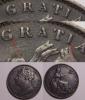
What do you think? There is also "I" over something

My guess is that the die suffered wear (or broke) on the "I" in GRATIA, and was repunched. The T may also have been repunched. Difficult to say about the G - it's possibly G over G?
The G in GEORGIUS is an interesting distance from the other letters.
The first "G" in "Georgius" is normally spaced like that on George IV farthings. The overstrike is interesting but not unexpected given the plethora of them in the George IV series. I've come across quite a few which aren't recorded.
-
It's most likely to be 1838 though the middle of the 3 looks a little strange - can you get it bigger and sharper?
Hello peckris,
Ive taken another photo as requested and hope that from this you will be able to determine the date if possible mate.?
cheers

How about looking at the reverse. If there's only one stop after FID then there's a good chance it's an 1838; two stops and it must be 1858. I've seen numerous 58s being sold as as 38s and vice versa.
G
-
Does anyone know of any book(s) specific to farthings.
Other than books covering the copper and bronze coinage (Peck, Bramah, Freeman etc), there are no specific farthing books that I am aware of. It is a project I am looking into at the moment. The Colin Cooke catalogues are the only other literature that used to have features on varieties etc.
The Colin Cooke collection sale catalogue of May 2006 itself provides a fairly detailed listing with many varieties (well illustrated in colour) from the earliest types through 1956. It also includes fractionals. Since this collection was probably the most complete ever assembled this constitutes good coverage of the series, although I noted a few items missed the sale such as the 1953 varieties, Colin's 1860 and 1864 copper farthings, etc. (I assume either held back from the sale or sold privately). You might check with the Colin Cooke website to see if the catalogue might still be available. Also, the website itself has a section on collections which documents this sale and the Oxford Collection sale.
I have a spare copy of the Cooke sale catalogue if you're interested in making me an offer. At one stage I ended up with four. It's still a very good record. I'm not sure what happened to the 1860 and '64 copper, but they were certainly not in the sale. I hope they're now in good hands.
G
-
it pops up in a few places.
1925 halfcrown had 1.5 million yet is worth more then the 809k 1930
There's something similar with 1835/36/37 half crowns. The 1835 is very hard to find yet the mintage figures are by no means low, but I suspect that they include a large number struck in 1835 but dated 1834. The very low mintage figures for 1837 (less than 1905) aren't borne out by the fact that you see a fair number of them, at least in lower grades. Again, I suspect that many more were struck in 1838 from 1837 William IV dies to make up a shortage while new designs for Victoria were still on the drawing board.
Geoff
-

i have recently come in possesion of a 1920, half-crown coin and i was wondering if anybody could help me by telling me how much it would be worth...
any suggestions?
its in good nick apart from two slight black marks on the crest side which i have ben told was during the forging of the coin.
please comment and help me with my task.
thank youYes, a picture would be helpful. The 1920 half crown can be an interesting one. The silver content had just been reduced to 50%, yet some are known to exist in sterling silver as before. There were also initial problems in getting the optimum alloy for the reduced silver content. Moreover, a lot of 1920s are still pretty weak strikes. Good examples above EF aren't easy to find.
G
-
Can you tell me more about this interesting medal with four generations of the Royal Family?
I notice "copyright" under the bust of Queen Victoria
?

It's a very common unofficial medal by Grueber commemorating Queen Victoria's Diamond Jubilee in 1897. The Three princes depicted eventually became Edward VII, George V and Edward VIII.
G
-
Hi,
New to the forum and fairly new to coin collecting.
Would like any ones thoughts on the 3 coins below, I presume they are a comemrative set but don’t know from when etc.
Thanks in advance for any help.


From left to right, these are commemorative medals for i) the abdication of Edward VIII 1936 ii) the silver jubilee of George V and Queen Mary and 1935 iii) the coronation of George VI and Queen Elizabeth 1937. None of them is in any way an official medal (i.e. approved by the king and issued by the royal mint) but look like a set put together as a commercial venture n 1937 to honour the "year of three kings" in 1936. They look attractive enough; is there any clue either on the box or the medals themselves as to the designer or the firm of issue?
Geoff
-
Note That I have looked and looked and have only found this particular piece on "medalsforsale" and know where else yet - as far as I can tell the reference to Cumberlad Jack only addresses the Hanover type pieces not this one -
So what am I missing here I hate to be a pain as this site is not that easy to use and I don't feel like anyone is taking my request seriously and I really want the info?????
The piece is brass it has young head vic on front with her coronation date, June 20th?, 1837 on the rev. St. Anthony slaying the dragon with the inscription, "I lost the reins by trampling on Liberty"
Some one please help?????????????????
Ben "new but frustrated" Peters
20 June 1837 is the accession date, not the coronation date. This is either an accession medal of a fairly common type or, as others have suggested, a gaming token.
-
Are the Britannia 50p and old style £1 being released? I've had all the other 2008s (new and old) for several weeks now, but not seen any since of our lovely Britannia!
I'm pretty sure they're not. I've not seen any and it's too late now for them to appear. The pre-Dent 2008 pennies came out fairly early as there's always a need for pennies.
Geoff
-
That thought had crossed my mind too Geoff!
I was in the UK over Xmas and didn't see any new type 20p, 1p or 50p's.
I'm surprised you didn't see any pennies. They've been around a while and are pretty common. The 20p is more elusive and I've not seen the 50p myself yet. The £1 is out now too and I've had a few in change. The 2p and 10p are quite handsome when you seem them in the flesh.
G
-
It's not just the new 20p which is causing a stir. Keep a lookout for the new 1p with a reverse die axis. I saw one yesterday.
Someone cheekily suggested that the Mint is doing this on purpose to get people to take an interest in the new designs.
Geoff
-
I offered someone £30 for one when it was a real unknown (also in the forum somewhere). Now it looks like there may be lots I'll abandon that offer and just look out for one.
The Chair of South Manchester Numismatic Society, of which I'm Secretary, contactd the Royal Mint on this one. They replied saying that it affected a whole batch and the figures are between 100,000 and 200,000 coins.
Geoff
-
The other day I was shown a new 20p coin which has the new Matthew Dent reverse but the obverse of its predecessor. Consequently it had no date as the new designs have the date on the obverse. It was clearly a mule and I wonder whether this is a one-off or whether there might be more of them out there. Something to look out for.
BTW - have you noticed that the effigies on the new designs are slightly larger than on the previous Ian Rank Broadley one, as well as being in shallower relief?
Geoff
-
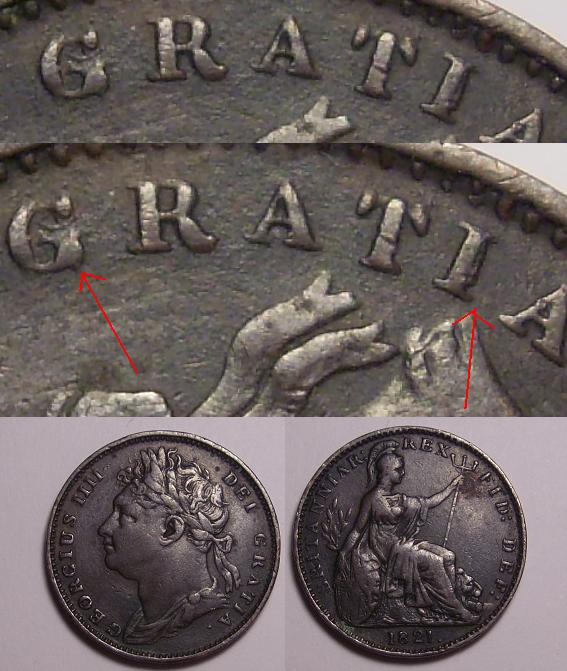
Hi
Got this couple of days ago
Scan is in 1200 look at the G in Gratia
Colin - I tried to email this to you but i think it disappeared!!
Cheers
This is why I'm developing quite an affair with George IV farthings. Given the small date run, the incidence of errors and varieties is remarkably high and by no means completely documented, so this one doesn't surprise me at all. I have inter alia an 1825 R over R in REX which I've not seen listed anywhere.
Geoff

2011 Edinburgh Pound Coin
in British Coin Related Discussions & Enquiries
Posted
The Belfast 2010 coins took a while to enter circulation, then seemed to be everywhere. I managed to get four in my change at once, but it was late 2011 or early 2012, and prior to that I'd only seen them in proof.
G