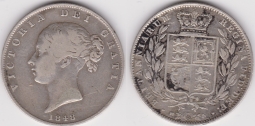
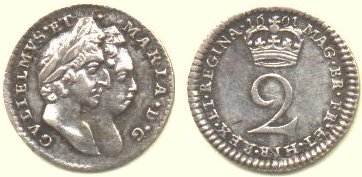
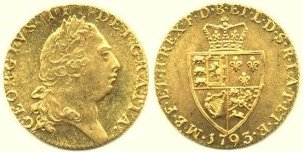
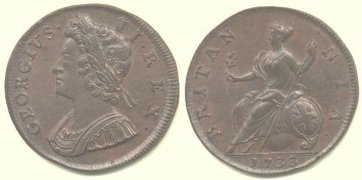
Modern Milled
I am very pleased to have been given permission to publish this very good 12 part history of British Coinage, written by Ken Elks. It contains a wealth of information on all era's of British coinage from the first Celtic coins until decimalisation.
Part 1, Celtic Coinage.
Part 2, Roman Coinage.
Part 3, Anglo Saxon Coinage.
Part 4, Norman and early English coins.
Part 5, Tudor coins
Part 6, Stuarts and the Commonwealth.
Part 7, Early Milled coins.
Part 8, Milled Coins 1662 - 1816.
Part 9, Provincial token coinage.
Part 10, The Great Re-Coinage.
Part 11, Decimal Coins.
Part 12, Scottish Coins.
Coinage of Great Britain. Celtic to Decimalisation, by Ken Elks.
Part 8, Milled 1662 - 1816.
History
The restoration of Charles II in 1660 marked the beginning of a period of change and expansion for Britain. The rebuilding of London following the Great Fire of 1666 is perhaps symbolic of the new start for the nation. The rapid development of the Industrial Revolution, the roots of which can be traced back to Elizabethan times, brought about tremendous changes in the structure of society, both political and economic, and had a lasting impact on the landscape, towns and villages throughout the land. During the process, Britain gained, almost by accident, a vast overseas Empire of dominions and colonies. This was brought about by a need to find new markets for manufactured goods and renewed competition with France. By 1816, Britain, a small group of islands, which, in the 16th Century comprised less than five million people, had become arguably the most powerful country in the world.
After the death of Charles II in 1685 he was succeeded by his younger brother, James, who became James II of England and James VII of Scotland. Within three years he proved so unpopular he was forced to abdicate and William of Orange and his wife Mary, daughter of James II, were invited to reign in his stead. Parliament took the opportunity to impose restrictions on the new rulers, the beginnings of the constitutional monarchy under which the country is still governed. When Mary died of smallpox in 1694, William continued as king until his death in 1701. He was succeeded by the second daughter of James II, Anne. One of the most notable events of her reign was the Act of Union, passed in 1707, finally uniting England and Scotland.
When Anne died in 1714 she left no direct heirs and the throne passed to George, Elector of Hanover, whose mother, Sophia, was a granddaughter of James I. George, in turn, was succeeded by his son, George II, and then his grandson, George III. During the long reign of the latter, Britain was to lose its American colonies in the War of Independence, and fight a protracted war against Napoleon of France.
War with France was a constant feature of the 18th Century, despite the Treaty of Utrecht signed in 1717. These were the War of Austrian Succession (1740-48), the Seven Years War (1756-1763), another with France and Spain which ended with the Treaty of Versailles in 1783, and then the Napoleonic Wars, which started in 1783 and were not finally to end until the battle of Waterloo in 1815. During the Seven Years War, Britain gained control of much of North America and Canada after the defeat of the French under Montcalm at Quebec and Montreal, only to lose the North American colonies during the American War of Independence 1773-1783. The Jacobites also received some support from France, when the "Old Pretender" James III, son of James II, tried to raise a rebellion in Scotland and again in 1745 under the "Young Pretender", Bonnie Prince Charlie, in 1745-46. The latter, at a time when Britain was embroiled in the War of Austrian Succession, came near to overthrowing the Hanoverian kings when Prince Charles and his army invaded as far south as Derby before being forced to retreat. In the final battle, at Culloden, the Scots army was annihilated.
In India the British fought a series of wars from 1746 to 1817 which eventually brought mastery of the whole sub-continent. The original intention was trade, via the East India Company, but French intervention and encouragement of native rulers to resist the British, led to subjugation and colonisation.
The Industrial Revolution was also accompanied by developments in agriculture, which brought about a remarkable improvement in the yield from the land and, following the enclosure of common lands, a gradual specialisation in farming which also gave greater efficiency. Without this it would have been impossible to feed the greatly increased population, which had doubled, to about 11 million people by 1816. Nor would it have been possible to support the greatly increased numbers who were called upon to serve in the army and navy (only 26,000 in 1714, 156,000 in 1761, and 291,000 in 1815).
The Coinage
The coinage throughout the period was milled, produced by a variety of machinery, though the old hammered coinage still remained as legal tender until 1696. Unlike previous eras, three basic metals were used, gold, silver and copper, the latter replaced temporarily by a tin coinage 1684-1693. During the reign of George III production of silver coins became spasmodic and mostly confined to the smaller denominations. Likewise the copper coins, in almost continuous production until 1754, virtually ceased until 1797 after a brief issue 1770-1775 and led first to widespread forgery to make up the shortfall and then the introduction of a provincial token coinage. In 1696, under William III, there was a recoinage of the silver denominations, to coincide with the withdrawal of the old hammered coins. This necessitated the setting up of provincial mints at Bristol, Chester, Exeter, Norwich and York until 1698 to produce the large quantities required. After the Union of England and Scotland, the mint at Edinburgh operated briefly in conjunction with the mint in London.
Mint | Mintmark | Period |
Bristol Chester Exeter Norwich York Edinburgh | B C E N Y E | September 1696 - September 1698 October 1696 - June 1698 August 1696 - July 1698 September 1696 - April 1698 September 1696 - April 1698 1707-1709 |
Gold & Silver Coins
Charles II initially issued four gold coins, originally based on the pound of twenty shillings value, but later this fluctuated in value and at one time the pound reached as high as 27 shillings. It was not until 1717 that the rate of exchange was fixed at 21 shillings. The name "guinea" applied to these coins was because the gold used in their manufacture was said to have originated in the country of that name in Africa. These four coins are therefore referred to as five guineas, two guineas, one guinea and half a guinea and were issued for most years until the 1730's.

William III five guineas 1701
The two larger denominations ceased during the reign of George II and only the guinea (until 1799) and half guinea (until 1801) continued to be issued thereafter. After an absence of 13 years, guineas (and a corresponding half guinea) were struck in 1813 with the sole purpose of paying the troops of the Duke of Wellington in Spain, from which it became known as the "military guinea". Two new small denominations, were minted, quarter guineas by George I in 1718 and George III in 1762 and third guineas by George III from 1797 to 1813.
In silver, there was the crown or five shilling piece, the halfcrown of two shillings and sixpence, the shilling, sixpence, fourpence, threepence, twopence and one penny. Although these latter four small denomination coins are often referred to as Maundy Money, most specimens were for general circulation until the early 19th Century. They ceased in 1800, having been minted in less than half of the years since 1760. Most of these silver denominations were produced intermittently after 1689 and the two larger ones ceased in 1751. There was a large issue of shillings and sixpences in 1758, then no more, apart from the "Northumberland shilling" of 1763 produced by the Earl of Northumberland principally for circulation in Ireland, until a copious issue of shillings and sixpences in 1787.

Both gold and silver coins until 1746 included various letters and symbols in their design to show the origin of the metal used in their manufacture. The first of these were the elephant, or elephant and castle mostly used on the gold and large silver coins to denote metal from Africa.
| MARK | ORIGIN OF BULLION | PERIOD |
|---|---|---|
| Elephant or elephant and castle | Africa | 1663 - 1726 |
| Plumes | Wales | 1698 - 1705 |
| Roses | West of England Mines | 1699 - 1739 (not continuously) |
| VIGO | Captured from the Spanish Fleet at Vigo Bay 1702 | 1703 |
| Roses & plumes | "Pitcoale & Seacole Company" | 1705 - 1743 |
| SSC | South Seas Company | 1723 |
| EIC | East India Company | 1729 - 1739 |
| LIMA | Silver captured by Admiral Anson | 1745 - 1746 |

George I shilling 1723, with SS C
*Image* George II "LIMA" halfcrown 1746

George III shilling 1787
This was the last major issue of shillings and sixpences before 1816
Copper & Tin Coins
The introduction of a copper coinage in 1672 was a major departure from the practice in previous reigns. During the Commonwealth and early years of Charles II the use of small privately produced token halfpennies and farthings in copper and brass had provided for the dearth of small change, necessary in day to day transactions. The new coins were legal tender for amounts up to six pence and comprised both farthings and halfpennies, weighing circa 5.5 gm and 11 gm respectively. Fairly large amounts of these coins were produced until 1679. The reverse featured a seated figure of Britannia, copied from second century Roman coins. It is said that one of Charles II's mistresses, the Duchess of Richmond, posed for it.
In 1684, because these copper coins had become the subject of extensive counterfeits, it was decided to switch to the use of tin, with a small central copper plug, the theory being that these would be almost impossible to copy. The weights of these coins approximated to those in copper. However, these coins began to corrode badly after a few years and in 1694 the metal reverted to copper. Large numbers of the new copper coins were issued by William III, then ceased during the reign of Queen Anne as it was thought that there were sufficient in circulation. A few farthings of Anne exist, minted in 1714 and at one time were thought to be patterns. This coin provided the inspiration for the halfpenny and farthing coins of George I, known as "Dump" issues because of their small thick flan. This disguised the fact that their weights were somewhat lower than those of previous reigns, circa 5 gm and 10 gm respectively.

George I "Dump" halfpenny 1717
Those of George II reverted to a more normal flan thickness and were produced almost continuously until 1763, some posthumously, the last coins of the reign bearing a date frozen at 1754.
George III produced large quantities of copper coin from 1770 to 1775 but after that they ceased. After ten years there was once again great shortages and extensive counterfeiting and the need was once more supplied, from 1787 onwards until suppressed in 1795, with widespread privately issued production of copper halfpenny tokens, together with some penny and farthing tokens.
Interim coinage reforms of George III 1797 - 1806
By 1797 it was obvious that the British coinage system needed drastic overhaul. Although gold guineas and half guineas had been struck in most years of the reign and continued until 1799, the large silver coinage had ceased due to an acute shortage of the metal. Only the small silver denominations, 4d, 3d, 2d and 1d were produced, at irregular intervals until 1786 and only in 1792 and 1795 thereafter, with a final issue in 1800 possibly to mark the beginning of the new century.
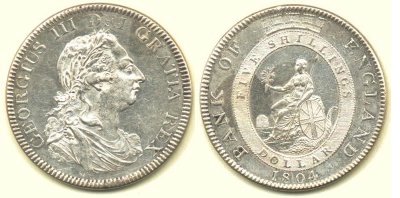
In place of the crown piece, captured Spanish American dollars, and even some French ecus and United States dollars, were counter-marked and issued as an emergency currency. Smaller pieces were also counter-marked and served in place of the halfcrown. In 1804, because forgeries of the counter-marks were prevalent, the mint took to completely restriking the Spanish dollars into what are known as "Bank of England Dollars". In some cases the date of the original coin can still be detected on the restrikes, from which it is known that although they are all dated 1804, the practice continued for several years.
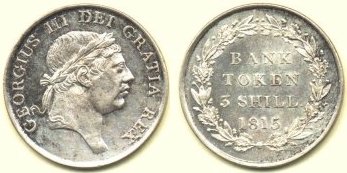
Because there had been no halfcrowns minted since 1751 and the supply of overstrikes had proved inadequate, between 1811-1816 the Bank of England issued its own tokens to the value of three shillings and for one shilling and sixpence. These were of silver and weighed 15 grams and 7.5 grams respectively. The denominations were chosen so as not to conflict with crown prerogatives. The shortfall in silver coins brought about the minting of large numbers of silver provincial tokens from 1810 onwards, until outlawed in 1815.
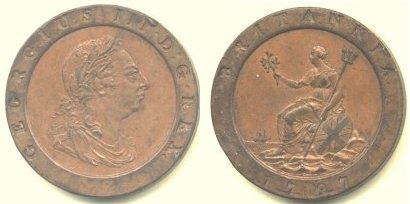
The first attempt at reform was by Matthew Boulton who secured a contract in 1797 to produce copper twopence and pennies at the Soho Mint in Birmingham. The idea was that the intrinsic value these coins, weighing two ounces and one ounce respectively, would correspond to their nominal value. Known popularly as the "Cartwheels", each was on a thick flan, with a wide rim incused with the legend. Both showed a seated figure of Britannia on the reverse. Such heavy and cumbersome coins were unpopular and most were melted down three years later when the price of copper rose. Halfpennies and farthings of a slightly reduced standard and different designs were introduced in 1799.
*Image* George III "Cartwheel" copper two pence 1797
Matthew Boulton recoinage

George III farthing 1799
In 1806 the copper penny was re-issued, this time smaller and lighter (19 grams, about two-thirds the weight of the earlier coin) and with a completely different design. At the same time copper halfpennies and farthings were also issued with similar obverse and reverse designs and weights in strict proportion to their value. These three coins set the weight standard for such denominations that continued until the change to the use of bronze in 1860.
Nevertheless, by 1810 shortages of bronze coins brought another flurry of local penny and halfpenny token issues. These tokens lacked the variety of the late 18th Century coins but, nevertheless, make an interesting, if largely lacklustre, series.
In 1816, now that the war with Napoleon had finally ended, the government finally turned its attention to a long-overdue major currency reform, the "Great Recoinage" of 1816.
Appendix I - Stuart and Hanoverian Kings & Queens
Charles II 1660 - 1685
James II 1685 - 1688
William III and Mary II 1688 - 1694
William III 1694 - 1701
Anne 1701 - 1714
George I 1717 - 1727
George II 1727 - 1760
George III 1760 - 1820