Stuart Coinage
I am very pleased to have been given permission to publish this very good 12 part history of British Coinage, written by Ken Elks. It contains a wealth of information on all era's of British coinage from the first Celtic coins until decimalisation.
Part 1, Celtic Coinage.
Part 2, Roman Coinage.
Part 3, Anglo Saxon Coinage.
Part 4, Norman and early English coins.
Part 5, Tudor coins
Part 6, Stuarts and the Commonwealth.
Part 7, Early Milled coins.
Part 8, Milled Coins 1662 - 1816.
Part 9, Provincial token coinage.
Part 10, The Great Re-Coinage.
Part 11, Decimal Coins.
Part 12, Scottish Coins.
Coinage of Great Britain. Celtic to Decimalisation, by Ken Elks.
Part 6, Coins of the Stuarts and the Commonwealth.
Note: Strictly speaking the Stuart kings cover the period between the death of Elizabeth I and 1688, when James II was deposed. For convenience, this section will only include coins up to 1662 in the reign of Charles II, when the old handmade hammered coins were produced for the last time, because this marks a fundamental transition in the history of coinage.
History
When James VI of Scotland became king of England as James I, there was renewed conflict between Catholics and Protestants, culminating in the Gunpowder Plot of 1605 when Guy Fawkes attempted to blow up Parliament and the king. It was a time of great religious ferment and an unresolved conflict between the powers of the king and Parliament that was a hangover from the reign of Elizabeth. The general unrest was also aggravated by periodic outbreaks of bubonic plague, the worst of which came in 1625. On the other hand the long drawn out war with Spain had fizzled to a close in the last years of Elizabeth with the death of Philip II. Likewise, the war in Ireland, which had been such a heavy drain on the country's finances, had also ended.
During the reign of Charles I, which began in 1625, his relationship with Parliament quickly deteriorated. Charles had inherited the autocratic views of his father, which found its expression in the "Divine Right of Kings" to rule as they saw fit. To make his situation worse, the marriage of Charles to a Catholic, the French princess Henrietta Maria, aroused great suspicion, aggravated when he became embroiled in a new and unsuccessful war with Spain and was unable to persuade Parliament to grant him the necessary funds to prolong it. When Parliament wanted to impeach the Duke of Buckingham, Charles' favourite, after the failure of a naval expedition against Cadiz, he dissolved Parliament for a second time. When, in desperation, Charles tried to raise money by imposing forced loans it was opposed by over 70 of the gentry who refused to contribute. Charles highhanded response was to have them arrested. He had even less success with his third Parliament, which sat from March 1628 until dissolved in March 1629. Charles then attempted to rule the country on his own for the next eleven years, making an enforced peace with Spain and also France, after an ill-fated expedition to La Rochelle in support of French Protestants.
During this period he imposed the so-called Ship Money, aimed at supporting the Royal Navy but widely opposed and a source of further unrest. In 1639 he found himself at war with his Scottish subjects over attempts to enforce Protestant reforms onto the Scottish Church. In the so-called Bishops Wars, Charles found himself out-manoeuvred and agreed to a truce, only be defeated when war broke out again the following year.
When, of necessity, Charles was forced to recall Parliament in 1640, the scene was set for confrontation, which culminated in the outbreak of the Civil War in 1642. On 22 November 1641 Parliament passed the Grand Remonstrance setting out all the wrongs committed by the king. When Charles tried to arrest of five members of Parliament who had opposed him, they escaped and this triggered off a rebellion. One of the decisive mistakes Charles made was to immediately leave London in order to find safety with his supporters, leaving Parliament in control of London and most of the south east of England by default.
For the first three years the war was only spasmodic, interspersed with abortive attempts at a peace settlement. In the opening battle, at Edgehill during October 1642, the Royalists gained the advantage, and the Parliamentary army was forced to retreat towards London. This was followed by further minor victories for the Royalists but the situation quickly became confused and the refusal of hard-liners to negotiate a peace with Parliament eventually rebounded on them. The battle of Marston Moor in July 1644 brought about a devastating victory for the Parliamentary forces and the fall of York, which had been under siege. Further Parliamentary victories at Naseby and Langport in 1645 eventually led to the surrender of Charles to the Scots, who had allied themselves with Parliament.
Charles was handed over to the English and held prisoner while negotiations were conducted with Parliament about how the situation might be resolved. Then in 1648 came a second Civil War, with a series of Royalist rebellions and the invasion of a Scottish army in support of Charles after a series of intrigues. All were defeated by the strong Parliamentary forces. Angry at what was perceived as treachery, the army insisted that Charles be put on trial. Having been found guilty, Charles was executed on 30 January 1649. His son was immediately proclaimed king by the Scots as Charles II.
During the next two years Oliver Cromwell, who had emerged as the new leader of the army, was engaged in putting down rebellions in Scotland and Ireland. He defeated the Scots army at Dunbar in September 1650 but Charles II had invaded deep into England and it was to be another year before Cromwell could finally beat him at the battle of Worcester. Despite being hunted for nearly seven weeks Charles II finally managed to escape to France.
The period of Parliamentary rule was termed the Commonwealth. Tensions grew with the army under Cromwell until he dismissed Parliament and took control himself as Lord Protector. After his death in 1658, his son Richard ruled instead, with notable lack of success, and circumstances began to favour a restoration of the monarchy. Charles II made clear his desire for reconciliation in the Declaration of Breda, April 1660. In May 1660 Parliament proclaimed Charles II king and he returned to England a few days later.
The coinage
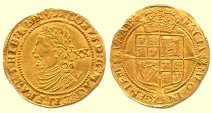
Coins of James I fall into three distinct groups, an initial issue 1603-1604, the second 1604-1619 and finally 1619-1625. The changes mainly affect the gold series. Most of the coins of the first issue bear the reverse legend EXURGAT DEUS DISSIPENTUR INIMICI ("Let God arise and His enemies be scattered"). The gold sovereign was produced on a large, thin flan and initially had a value of 20 shillings. Those of the second issue are usually referred to the unite, from the reverse legend FACIAM EOS IN GENTEM UNAM ("I will make them one nation") referring to the king's intention for the union of both his kingdoms. Due to a rise in the price of gold, these coins were revalued in 1612 at 22 shillings. In the third coinage the unite was replaced with a coin known as the laurel (from the laureate bust of the king on the obverse), which was lighter and valued at 20 shillings. Other gold coins reflecting similar value and weight revisions were the half sovereign (later called the double crown and then half-laurel), the crown (later the quarter-laurel) and the halfcrown. In parallel with the gold issues, both the crown and halfcrown were also produced in silver, depicting the king on horseback.

James I gold unite - Second coinage 1604-1619
*Image* James I gold laurel - Third coinage 1619-1625
with value mark XX (20 shillings)
Photo courtesy of Vosper Coins (see links)
Occupying what was, by now, an anachronistic position, were the gold ryal of 30 shillings (value mark XXX) and the half or spur ryal of 15 shillings (marked XV), together with the gold angel and half angel. Except for the angel, which survived until 1643, these were the final issues of these denominations.
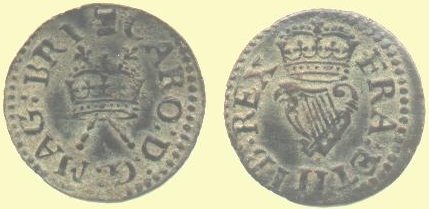
James I also produced shillings, sixpences, half groats, pennies and halfpennies in silver. An important step was the introduction of the copper farthing. Hitherto English monarchs had refused to countenance the idea of a base metal coinage but James, with his experience of such coins in Scotland, licensed Lord Harrington to produce them. Later this licence passed to the Duke of Lennox. The first Harrington issues were on a small flan and given a surface coating of tin, possibly to continue the fiction of a silver coinage. His later farthings and the Lennox issues were on a larger flan and omitted the tin surface.
This practice continued into the reign of Charles I. The Duke of Lennox became the Duke of Richmond shortly before he died and the patent passed to his widow. These coins are known as the Richmond or Royal issues. From 1634 farthings were minted under a licence sold to Lord Maltravers. Due to the large number of copies that began to circulate the design was changed to include a small brass plug which made them almost impossible to forge. These plugged coins are known as the Rose farthings from their reverse design showing a Tudor rose.
The reign of Charles I is probably the most interesting, numismatically, of all the English coins. This is mostly because of the changes in design, a new gold denomination (the triple unite), the experiments with a milled coinage by Nicholas Briot and the provincial mints that were opened during the Civil War. To these must be added the various siege issues, most of which consisted of pieces of metal cut from silver tableware and stamped with their value, most notably the diamond shaped "coins" of Newark with OBS NEWARKE in 1645-1646.
Coins of Charles I fall into two periods, 1625-1642 and those during the Civil War 1642-1648. In the early period the gold denominations consisted of the unite of 20 shillings (marked XX), double crown (X) and crown (V), besides the angels mentioned previously.

Charles I gold crown - 1632-1641
Tower mint - mintmark: Crown
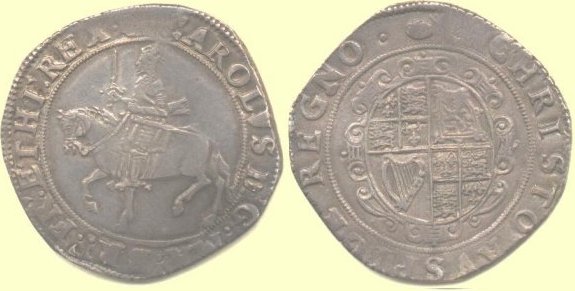
Silver coins consisted of the crown and halfcrown, both showing the king on horseback, shilling (value mark XII), sixpence (VI), halfgroat (II), penny and halfpenny, all produced at the Tower Mint in London. When a new mint was opened in Aberystwyth in 1638 to exploit the output from Welsh silver mines, it produced shillings, sixpences, threepences, halfgroats, pennies and halfpennies, plus groats, all bearing the three ostrich plumes emblem of the Prince of Wales as a mintmark.
*Image* Charles I Halfcrown 1625-1642
Tower mint

Charles I shilling 1635-1639
Tower mint - mintmark: star
When, in 1642, the Civil War broke out, the Tower mint fell into the hands of Parliament who continued to issue coins in the name of Charles I bearing his portrait and using the same reverse designs. Charles was forced to open a mints in Shrewsbury and Oxford from which he issued the gold triple unite (value mark III) with the reverse design consisting of what is known as the Declaration - RELIG PROT LEG ANG LIBER PAR ("The religion of the Protestants the laws of England and the liberty of Parliament"). Other denominations from these two mints included the large silver pound, halfpound, crown and halfcrown, with similar reverse and value marks of XX, X, V and 2.6 respectively. Production at Oxford continued until 1646 and included other denominations. Other Royalist mints were opened at York, from 1643 until its capture by Parliament in 1644, Bristol (1643-1645, Exeter (1645-1646), Truro (1642-1643), Worcester (1643-1644) and Chester (1644). Siege issues included Carlisle (1644-1645), Newark and Scarborough, the latter excessively rare.
Coins referred to as the Late Declaration issues, were minted during 1645 and 1646. These have been variously attributed but may have been made at a travelling mint. They bear the mintmark A or B and at one time were thought to have been struck on Lundy Island in the Bristol Channel. This has now been discarded in favour of Asby de La Zouch in Leicestershire and Bridgnorth, Worcestershire. During 1648-1649 a mint was operated at the Aberystwyth silver mills, because the castle, where the original mint had been sited, had been destroyed. This is referred to as the Aberystwyth Furnace mint.

Commonwealth shilling 1651
During the Commonwealth a standard design was used on all coins, consisting of an obverse showing the shield of St George within a wreath and the legend THE COMMONWEALTH OF ENGLAND and reverse with date, value mark and legend GOD WITH VS with two shields, that of St George and that of Ireland (the smaller denominations, two pence, penny and halfpenny omitted the date and legends). The conjoined shields on the reverse led to these coins being called "Breeches money". They were struck in most years from 1649 to 1660. In gold these consisted of the unite, double crown and crown, and in silver, the crown, halfcrown, shilling, sixpence, halfgroat, penny and halfpenny. At the same time Blondeau and others conducted experiments in a milled coinage, including a series of patterns with the portrait of Oliver Cromwell.
After the restoration hammered coins were only produced for the first years of Charles II, ceasing in 1662. The denominations were the same as those of the Commonwealth with the addition of a groat and a threepence. Thereafter only machine made milled coins were minted.
Appendix 1
The Stuarts
James I 1603-1625
Charles I 1625-1649
Charles II 1660-1685
James II 1685-1688
The Commonwealth 1649-1660 (including Oliver Cromwell as Lord Protector 1656-1658)