Roman Coinage in Britain
I am very pleased to have been given permission to publish this very good 12 part history of British Coinage, written by Ken Elks. It contains a wealth of information on all era's of British coinage from the first Celtic coins until decimalisation.
Part 1, Celtic Coinage.
Part 2, Roman Coinage.
Part 3, Anglo Saxon Coinage.
Part 4, Norman and early English coins.
Part 5, Tudor coins
Part 6, Stuarts and the Commonwealth.
Part 7, Early Milled coins.
Part 8, Milled Coins 1662 - 1816.
Part 9, Provincial token coinage.
Part 10, The Great Re-Coinage.
Part 11, Decimal Coins.
Part 12, Scottish Coins.
Coinage of Great Britain. Celtic to Decimalisation, by Ken Elks.
Part 2, Roman Coinage.
Roman coins circulated in Britain from Celtic times, even before the conquest by the emperor Claudius in A.D.43. Following the occupation normal Roman coins were then used for some 250 years before Britain had its own mint. However, the Romans issued many coins with reference to Britain, including gold coins of Claudius showing a triumphal arch inscribed DE BRITANN, commemorating the conquest.
The initial phase of the conquest established a frontier from roughly the Severn Estuary to the Wash. The Britons were mostly allowed to retain their rulers, serving as client-kings of the Romans. Unfortunately for the Britons, Roman ambitions did not stop there and after a series of punitive raids beyond the frontier, the suppression of the Boudiccan rebellion and a period of consolidation which saw Roman rule extended into Wales, a decision was made to occupy the whole of the country. Accordingly Cnaeus Julius Agricola, governor of Britain, was given the task of subduing the whole of the country, which he did with typical Roman thoroughness in a bloody campaign that lasted some seven years from A.D. 77-83.
Following a visit by the emperor Hadrian A.D. 122, the frontier was set from the Tyne to the Solway Firth, along what we now call Hadrian's Wall, abandoning those lands in Caledonia (Scotland) conquered by Agricola which extended as far north as the glens. This proved only temporary as Hadrian's successor, Antoninus Pius (A.D. 138-161) moved the frontier back to Scotland, building a new wall in the isthmus between the Clyde and the Forth following attacks by the northern tribes in A.D. 140-144. This Antonine Wall remained the border until the reign of Commodus when, in A.D. 180, the northern tribes overran the frontier and inflicted a heavy defeat on the Roman army. This rebellion was ruthlessly suppressed by a newly appointed governor, Ulpius Marcellus, and peace restored.
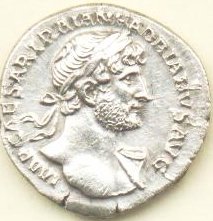
Coins commemorating the visit of Hadrian included sestertii with reverse legend BRITANNIA, depicting a seated Britannia. This was the prototype of the figure used 1300 years later on British coins. Others referred to the garrison and were inscribed EXERC(itus) BRITAN(niae). They show Hadrian addressing a group of soldiers.

Bronze sestertius of Antonius Pius AD 138-160 depicting Britannia
The Britannia coin was repeated by Antoninus Pius (see photo above), together with others struck in gold and bronze, with reverse legend IMPERATOR II BRITAN, which have either a winged figure of Victory or Britannia. These are thought to commemorate the victories of Lollius Urbicus against the tribes around the Wall. Commodus also issued coins with either BRITANNIA or VICT(oriae) BRIT(annicae) on them.
The respite proved only temporary, as civil war followed the death of Commodus in A.D. 193. The garrison of Britain was withdrawn to fight the cause of Clodius Albinus and perished with him at the Battle of Lugdunum (Lyons, France) in A.D. 197. Taking advantage of the Roman garrison's temporary weakness, the northern tribes again devastated the province. Hadrian's Wall was so badly damaged during the attacks that in places it required completely rebuilding. Although order was restored with some difficulty, the new emperor Septimius Severus arrived from Rome in A.D. 208 with a vast army intending to resolve the problems with the northern tribes once and for all. In three years of campaigning, which took the Roman army to the north of Scotland, they obeyed the command "Let nobody escape destruction, no one, not even the babe in the mother's womb". The decimation of the highlands caused by this was such that it was over 100 years before the inhabitants of Scotland were able to mount an effective attack again. This population vacuum was, in the interim, filled by Gaelic tribes from Ireland, the Hibernae, replacing or augmenting the surviving Scots.
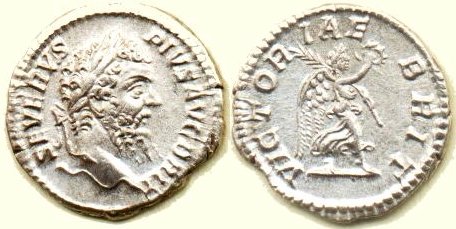
In A.D. 211, Severus died at York. His two sons, Caracalla (Marcus Aurelius Antoninus Pius - Antoninus III in some old books) and Geta hastily returned to Rome to secure their inheritance. The Severans issued coins in gold, silver and bronze commemorating their campaign in Britain, all bearing the legend VICTORIAE BRITANNICAE in full or abbreviated, as well as adding the honorary title Brit(annicus) to their name on the obverse.
Thereafter, Britain enjoyed nearly a century of peace and relative prosperity before being subjected to the next series of attacks. These began in the late 3rd Century A.D. when sea-going pirates from Ireland in the west and Saxons from Scandinavia in the east began raiding the coastal towns of Britain. To meet these attacks, two fleets of ships were set up, that in the east being based on Boulogne and called the "Classis Britannica". It was commanded by a Menapian called Carausius who rebelled and proclaimed himself as emperor of Britain and Gaul. Six years later he was assassinated by enemies within his own court and his finance minister Allectus became emperor in his place. The reign of Allectus was brief because in A.D. 296 the newly appointed ruler of the western provinces of Rome, Constantius Chlorus (Constantius I), invaded Britain and recovered it for the Empire.
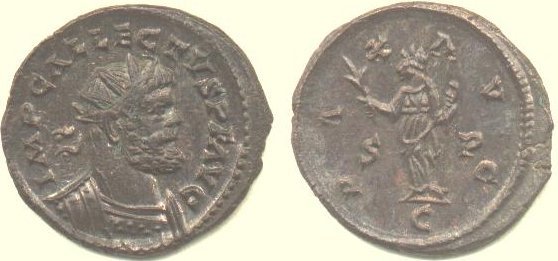
During the reigns of Carausius and Allectus, coins were minted in Britain for the first time for 250 years. Two mints were involved, one with mintmark including the letter L which had to be Londinium (London) and another with signature C or CL. The attribution of this mark has been questioned for many years and at one time Camulodum (Colchester) was favoured, then Clausentum (Bitterne, near Southampton). It has never been satisfactorily resolved where this mint was situated. Other coins of Carausius bear no mintmark at all, while others have the letters RSR. For the early part of his reign, Carausius controlled a large part of Gaul along the Channel coast and one mint, whose coins are sometimes marked R, is thought to have been Rotomagus (Rouen) in northern France.
Above: Silver "denarius" of Carausius, "RSR" mint
British Museum Collection
Four denominations were involved, in gold, silver and silvered bronze for Carausius and Allectus and a smaller, unknown, bronze denomination for Allectus, usually called a quinarius as they always have the letter Q on them. Among the antoniniani of Carausius were coins showing conjoined busts of himself with the two rightful joint-emperors, Diocletian and Maximian and the legend CARAVSIVS ET FRATRES SVI (Carausius and his brothers).
With the restoration of official Roman rule, a decision was made to continue minting coins in London. This was an extension of the decentralising policies of Diocletian, which included splitting up the Empire into four administrative areas and increasing the number of mints producing coins instead of just relying on one mint in Rome. Coins in silvered bronze were produced in London from A.D. 296 to A.D. 325. Initially these were a large denomination called a follis, struck in the name of Diocletian and his co-emperors, Maximian, Constantius and Galerius, who formed the First Tetrarchy. When Diocletian and Maximian abdicated in A.D. 305 Constantius and Galerius were promoted to Augusti (emperors) they were replaced by two others as juniors, Severus II and Maximinus II to form the Second Tetrarchy.
This arrangement did not last for long. While in Britain to repulse an invasion of the north by a new enemy called the Picts, Constantius died and his troops elevated his son Constantine (later known to history as Constantine the Great) to replace him without waiting for the agreement of the other Tetrarchs. A period of confusion followed, with others making their play for power, among them Maxentius, son of Maximian, who rebelled against Severus II and killed him. Constantine, who had been downgraded to a subordinate rank by the Tetrarchs, formed an alliance with Maximian and marched on Rome, defeating Maxentius at the battle of Milvian Bridge, to become sole ruler of all the western provinces in A.D. 312. Galerius had died the previous year and his two successors in the east, Licinius and Maximinus II quarrelled A. D. 313 over territorial claims and in the ensuing battle Licinius was victorious. For another eleven years there was an uneasy peace between the two halves of the empire until A.D. 324, when victories over Licinius at Hadrianople and Chrysopolis left Constantine as sole ruler of the whole of the Empire.
During this period the London mint produced coins for all of the various rulers. The cost of wars meant that the original follis was gradually reduced in weight and size from circa 10 gm and a diameter of 27 mm in A.D 296, to only 3 gm by A.D. 322. The later coins were struck on thinner flans and maintained an average diameter of around 17mm to 19 mm. After A.D. 317 and the final split with Licinius, Constantine only issued coins for himself, his mother Helena, wife Fausta and his three sons, Crispus, Constantine II and Constantius II, ignoring Licinius completely.
During the whole of its operations the London mint produced no less than 587 different combination of obverse and reverse types and mintmarks, 287 in the period A.D. 296-312, the rest up to A.D.325. Thereafter the mint was closed. During this time the system was that the two co-emperors had the rank of Augustus (abbreviated to AVG) and the two junior emperors the rank of Most Noble Caesar (NOB CAES or just N C on the coins).
Constantine divided Britain into four administrative areas, First and Second Britain, Maxima Caesariensis and Flavia Caesariensis, partly to prevent any commander doing what Constantine himself had done. By this time Britain had become the granary of the western provinces, as Egypt was to those of the east, and too important to take risks with. The size of the legions was reduced but the number of auxiliary and cavalry units was greatly increased. The fleet was similarly strengthened. In the process the Roman army became much more mobile.
When the Picts invaded the north in A.D. 343, Constantine's son Constans, now emperor of the West, crossed hurriedly to Britain and drove them off. Again, in A.D. 360 when the same tribes broke the treaty, the new emperor, Julian, had to send reinforcements from Gaul. These were minor compared with the attack a few years later A.D. 369, when all the barbarians, Picts, Scots, Saxons together with a new enemy called the Attacotti, attacked in unison. The most able general of the Roman army, Count Theodosius, father of the later emperor with the same name, defeated them so effectively he was able to annexe a new province to the empire, presumably from beyond Hadrian's Wall, naming it Valentia after the reigning emperor.
Peace was short-lived. In A.D. 383 the commander of Roman army in Britain, Magnus Maximus, was proclaimed emperor by disgruntled troops and invaded Gaul, taking most of the army with him. The emperor Gratian was defeated and killed and Maximus became ruler of Britain, Gaul, Spain and North Africa. Then in A.D. 388 he decided to advance on Rome, was beaten at Poetovio by the emperor Theodosius I and killed.
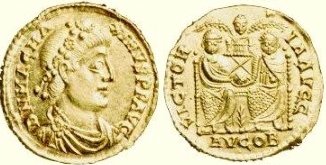
*Image* Gold solidus of Magnus Maximus minted in Augusta (London)
Mintmark: AVGOB ( Augusta Obryziacum)
During the brief reign of Maximus a mint was set up in London (renamed Augusta) producing gold and silver coins with the mintmark AVG, all of which are extremely rare.
That Britain did not fall victim to another barbarian invasion after being denuded of its garrison is a tribute to a system of foederati, which at first worked extremely well. This entailed settling barbarian tribes in frontier areas liable to attack, thus two Germanic tribes, the Votadini and the Damnoni were allocated to North Wales and the north of England respectively and other mercenaries were employed in Kent. North Saxon mercenaries were also employed against a new attack by the Picts. Stilicho, a Vandal general in the army of the emperor Honorius, came to Britain late in the fourth century to organise the country's defences. His efforts were negated a few years later when in A.D. 407 the legions in Britain declared one of their number, Constantine, as emperor and invaded Gaul to lay claim to the throne, chosen, apparently, because of his name and it was the centenary of Constantine the Great's elevation. Following his eventual defeat in A.D. 411, the garrison of Britain was never replenished and when a deputation from Britain was sent to Rome in A.D. 446 it carried a letter with the famous phrase "The barbarians drive us into the sea and the sea drives us back to the barbarians". No help was forthcoming. A few years later a foederati king called Vortigern invited the Saxons to occupy the south and effectively Roman rule was at an end. The Romano-British tribes were gradually pushed back into Wales, Devon and Cornwall and by the late 7th Century all of England had come under the control of the invaders.
Appendix 1. THE ROMAN COINAGE SYSTEM
From the time Augustus (27 B.C.-14 A.D.) until the middle of the 3rd Century, the Roman monetary system consisted of a number of denominations struck in four different metals, gold, silver, orichalcum (a kind of brass) and copper. During the latter half of the 3rd century on coins of gold and a silver-washed bronze alloy were issued. Silver coins made their appearance again in the early 4th Century, and were produced in substantial numbers from about AD 350 onwards until the joint reigns of Arcadius and Honorius at the end of the Century. Thereafter, silver coins are quite scarce.
An important point to remember concerning Roman coins is that after AD 214 we are mostly unaware of what the Romans called the various new denominations introduced. Most names in common use are those allocated to them buy latterday numismatists.
Very often these coins are listed with a set of relative values ascribed to them, for example the gold coin or aureus is quoted as being worth 25 silver denarii. A reading of Roman documents shows that this is a modern interpretation. The actual system is more complicated.
What needs to be understood is that the medium of exchange was the base metal coinage and that gold and silver were only for the convenience of storing or transporting large sums of money. Only when silver coins had themselves become so debased they were virtually copper did they supplant the base metal coins for transactions. All prices were therefore quoted in terms of the brass sestertius, with a nominal value of a quarter of a denarius, and all payments in the market place were made using that coin or one of the smaller brass or copper denominations. Before spending a gold or silver coin it had first to be exchanged with the money-changers for its current value in these base metal coins. You could also buy gold and silver coins from the money-changers. Either way you paid a premium, rather like today when obtaining foreign currency.
What the table below shows therefore, is what is thought to be the approximate relative value of the various denominations, but there is no certainty of their correctness or for how long a period they applied.
Metal | Denomination | Value |
|---|---|---|
Gold | Aureus denarius | 25 silver denarii |
Gold | Aureus quinarius | 121/2 silver denarii |
Silver | Denarius | 4 sestertii or 16 copper asses |
Silver | Quinarius | 2 sestertii or 8 copper asses |
Orichalcum | Sestertius | 4 copper asses |
Orichalcum | Dupondius | 2 copper asses |
Copper | As | 4 copper quadrantes |
Copper or orichalcum | Semis | Half an as or two quadrantes |
Copper | Quadrans | Quarter of an as |
The first 200 years of the Roman Empire saw little change in this system, except that the silver denarius was progressively debased from the time of Nero onwards (A.D.54-68) and was accompanied by a series of downward adjustments in the weight of the gold coins (which were always struck pure).
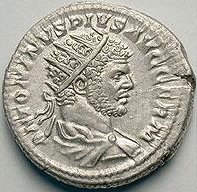
Silver antoninianus introduced by Caracalla AD 214.
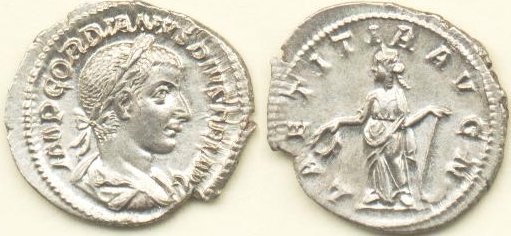
During the reign of Caracalla (A.D.211-217) a new denomination was introduced, a base silver coin which we call the antoninianus after a passage in the Scriptores Historiae Augustae, which refers to a gift of "argentos antoninianos mille" ("one thousand silver antoniniani "- SHA, Firmus, Saturninus, Proculus and Bonosus, XV.8). This coin always shows the emperor wearing a radiate crown (see photo above) or, in the case of empresses, showing the portrait bust set on a crescent. These coins weighed about one and a half denarii but were probably valued at two denarii. Following what proved to be the last major issue of denarii by Gordian III (A.D. 238-244), the antoninianus virtually supplanted the denarius as the main silver coin produced. In the reign of Trajan Decius (A.D.249-251) antoniniani were overstruck on denarii from earlier reigns. At the same time an orichalcum double-sestertius was introduced but was not continued into following reigns, though some were struck by Postumus in the breakway Gallic Empire (A.D. 259-268), just before the sestertius ceased to circulate.
After the financial collapse during the sole reign of Gallienus (A.D. 260-268) the antoninianus was reduced to a small coin of less than 4% silver with a silver wash to keep up its appearance. All the orichalcum and copper coins ceased production because they were worth more intrinsically than the so-called higher denomination. During the whole of this period, because it was pure, the gold coinage occupied what at first sight looks like an anomalous position, but it is fairly obvious that the money changing system would have coped by adjusting the number of base metal coins obtained for it, or required for its purchase.
*Image* Post reform silver-washed antoninianus of Aurelian circa AD 273-275
Reverse: ORIENS AVG
Mintmark: XXIA
Aurelian (A.D. 270-275) attempted a currency reform that brought a measure of stability. The antoninianus was produced at something like its original size and although the outer silvering was improved, the actual silver content remained low. These reformed antoniniani often bear the mark XXI (or the Greek letters KA which mean the same), thought to refer to the ratio of 20 parts copper to one of silver in their composition. There was brief experiment in producing smaller denominations, including a base metal denarius. The antoninianus remained the standard coin until the reforms of Diocletian in A.D. 296. The gold coinage was struck at a variety of weights, which stabilised into two distinctive denominations by the reign of Carus and his sons (A.D. 282-285)
Diocletian's first step was to improve and stabilise the weight of the gold coins at 1/60th of a Roman pound in weight, then reintroduce a pure silver coin, which we call the argenteus, which weighed 1/96th of a pound. Both coins approximated to standard of the coins in the time of Nero over 200 years earlier; with, possibly, similar relative values. The silver-washed antoninianus was abandoned, it's place taken by a similar coin without the silver content. For want of a better name this coin is called a "post-reform radiate". A new denomination, weighing some 10 grams appeared. Again, we do not know what this coin was called but it is usually referred to as a follis. Like the antoninianus it was of approximately 4% silver with a silver wash and consequently the XXI mark was transferred to this coin. It is possible that this coin was initially valued at approximately 1/100th of an aureus
As part of Diocletian's reforms the number of mints was greatly expanded. In the early empire the sole central mint at Rome sufficed, but the numbers had grown considerably in the 3rd Century because of the vast quantities of coins needed to be produced. The follis was minted at all of them, initially with a standard reverse type, GENIO POPVLI ROMANI (The Genius - i.e. spirit - of the people of Rome). Mintmarks, the use of which had also been developing in the late 3rd Century, were included on nearly every coin, made more necessary because of the standardisation of reverse types.
The large folles barely survived Diocletian's reign and from A.D. 307 were progressively reduced in size and weight to a coin of only 17 mm diameter and under 2 grams by A.D. 330. By then, Constantine the Great (A.D.307-336) had in his turn initiated his own reforms. The gold coinage was reduced in weight to a standard of 1/72nd of a pound, a weight which continued for several hundred years, as a consequence of which it became known as the solidus. Late in his reign, the argenteus was reintroduced, but is usually referred to as a siliqua, together with a silver coin weighing the same as the solidus which we call a miliarense (to compound matters there were so-called heavy miliarensia of 1/60 th of a pound which occupied the same position relative to the earlier gold coins of the reign.
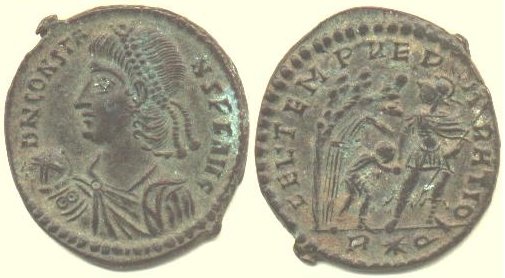
In A.D. 346, Constantine's sons and successors, Constans and Constantius II, discontinued the small follis derivatives and replaced them with a new silver-washed bronze coin of about 23 mm diameter. The name of this new denomination is unknown but has been called the centenionalis, which suggests that the value assigned to it was at first the same as the follis of Diocletian, the lighter weight because it was 1/100th of a gold solidus. At first they always bore the reverse legend FEL TEMP REPARATIO (Restoration of times of felicity). During his sole reign, after the death of Constans, Constantius II discontinued the original siliqua and replaced it with a coin of 1/144th of a pound. His coinage, therefore, consisted of the gold solidus and its half piece, the semis, occasional production of the miliarense, which seemed to have a ceremonial significance, and the light siliqua in silver and the centenionalis. By then, the centenionalis had followed the pattern of earlier silver-washed bronzes and declined to a quarter of its original weight and a size of 18mm.

Valens silver miliarense minted at Trier
Reverse: VICTORIA AVGVSTORVM
Mintmark TRPS.
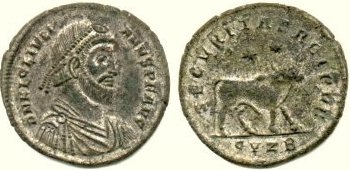
During the reigns of Julian, Jovian, Valentinian and Valens, following the example of the ururper Magnentius in Gaul, attempts were made to introduce a larger silver-washed bronze approximating to the original centenionalis. Similar attempts with a slightly smaller coin in the reigns of Gratian and Theodosius I were equally short-lived. With only minor adjustments to the weight and size of the bronze coinage, this continued to be the monetary system until the reforms of Anastasius in A.D. 498, by which time the western provinces had all been lost to the Roman empire.
Appendix 1.
Late Roman bronze coins are usually defined by their size as a handy notation. These are:
| AE1 | Over 25 mm diameter |
| AE23 | 23 mm to 25 mm diameter |
| AE3 | 17 mm to 23 mm diameter |
| AE4 | less than 17 mm |
Occasionally, borderline coins are referred to as AE3/4 or AE2/3.
Appendix 2. BARBAROUS COINS
Forgers exploited ignorance of newly introduced coin types and the illiteracy of the population, by producing imitations of Roman coins on a huge scale. These contemporary forgeries are interesting and worthy of study in their own right and appear to emanate from specific centres of production in, for example, Gaul. They can usually (but not always) be distinguished by poor workmanship, blundered legends, and incorrect die axis (with official Imperial Roman coins the die axis of the reverse is exactly the same as obverse, with the design either the same way up or upside down - with forgeries the axes are usually at an angle with one another).
These forgeries come in two types. Copies of early silver denarii were made which have a base metal core inside a thin "envelope" of silver. These were especially prevalent during the Roman Republic and virtually ceased when the silver coins became heavily debased. Money-changers took to testing silver coins by striking with a sharp instrument designed to pierce through the outer covering and show the core. Many early denarii exhibit these test marks.
The others were copies of bronzes, which come in waves and tend to follow the introduction of new coin types. In the 1st century, copies of the copper as of Claudius abound. Thereafter there was a lull until the 3rd Century when cast copies of base silver denarii were made. Following the collapse of the Gallic Empire (A.D. 260-273) set up by the rebellion of Postumus, there was a vast outpouring of what are called "barbarous radiates", forgeries of the last greatly debased antoniniani. No sooner had this coinage subsided than the rebellion of Carausius provided the impetus for more copies. A high proportion of so-called Carausian coins are nothing more than contemporary copies, and their uncritical inclusion in reference works greatly hampered studies of his coinage.
The constant changes to the bronze coins in the 4th Century brought successive waves of imitations. Especially favoured were the URBS ROMA and CONSTANTINOPOLIS coins of Constantine and the FEL TEMP REPARATIO coins of Constantius II.
In the final phase many of these copies were extremely small, some barely 5 mm diameter and are often called minims or minimissimi.
A final note concerns the late 4th Century siliquae. Many of these are found clipped, something that was difficult to do on earlier silver coins but relatively easy on the thin flan siliqua. These are not, of course, forgeries as such.
Appendix 3. COIN HOARDS & SITE FINDS
There is a wide divergence between the sort of coins found on an average Roman archaeological site in Britain and in hoards. A common feature of early sites is the large number of "plated" forgeries of denarii that are found, coins that are rarely hoarded. This was because possession of a forgery was high treason and rather than risk execution, anyone finding that they had one quickly got rid of it. There is a major difference in the coins that are found. Large bronzes are rarely hoarded but abound in site finds, the exception being mid-3rd century hoards from the reign of Postumus when they had acquired a significant value. Emperors whose coins are rarely found on sites sometimes occur commonly in hoards. For example, antoniniani of Gordian III to Valerian I; in fact the pattern of site finds is such that absence of what appears to be common coins does not mean that the site was unoccupied during that period.
Coin hoards tend to be deposited following major coinage reforms. At one time it was thought that they were the result of some disaster, an argument that had to be strained at times to equate the end of a hoard by the date of the latest coin in it with some known event, with all kinds of special arguments being put forward to explain the gap. For example, a 30 year lapse in time had to be explained as the time it took for a coin to be minted in Rome and then arriving at the frontier. The trouble with that argument was that it had to be equally applied to hoards of a similar type found nowhere near the frontier and in areas that had not suffered the same disaster. Nowadays the economic arguments are more widely accepted.
Appendix 4. ROMAN EMPERORS KNOWN TO HAVE VISITED BRITAIN
Julius Caesar 55 and 54 B.C.
Claudius A.D. 43
Vespasian A.D. 43 as Legate of Legion II during the invasion
Hadrian A.D. 122
Pertinax - Governor of Britain during the late 2nd Century
Clodius Albinus - Governor of Britain A.D. 193
Septimius Severus A.D. 207-211, died in York
Caracalla A.D. 207-211
Geta A.D. 207-211
Carausius A.D. 287-293
Allectus A.D. 293-296
Constantius I A.D. 296 and A.D. 306, died in York
Constantine the Great A.D. 306-307
Constans A.D. 346
Magnus Maximus - Army commander A.D. 383 (and possibly his son Flavius Victor as well)
Constantine III - Army commander A.D. 407 (and possibly his son, Constans)