Coin Grading
Probably the most controversial and by far the most important area of coin collecting. Grading issues have caused disputes between buyers and sellers since collecting begun and it will no doubt continue to do so for ever more.
For a lot more information on coin grading, including descriptions for each coin type and large pictures of where to look out for the wear, please see this fantastic book written by Derrek Allen and published by me: "The Standard Guide to Grading British Coins 1797-1970" (links to Amazon, but the book is also available elsewhere).
I strive to always provide accurate grading of all coins sold, valued and purchased and have a very good record regarding this.
Grading coins accurately is a skill acquired in time and after looking at many similar/identical coins in all ranges of condition.
This page deals just with the grading of Modern coins. (i.e coins 'milled' to a good standard) When British coins are concerned 'Modern' is usually considered to be after 1790 (The latter half of George III Reign). Please be aware that the guide refers to the British Grading System. Just to confuse things, many countries have their own names in their own languages for the various grades and these are listed in the chart here:
Grading is subjective to a degree, and very difficult to do without actually seeing the coin you want to grade, however the following rough rules can be followed and there are pictures of coins in the collectable grades.
Coin grades are usually referred to as the coin's 'condition' and there are quite a range of conditions that are usually represented by initials. The basic 'conditions' are:
Poor:
A coin that is usually barely identifiable, often with some of the writing/date worn away. Coins in this condition are not usually wanted by coin collectors unless very very rare, but can still have sentimental historical value.
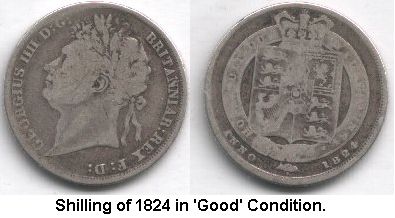
Fair/Good:
Click here for an Example.
Confusingly 'Good' coins are not really that good at all. Usually although very worn Good coins should be identifiable with clear dates. All the writing and main designs should be distinguishable. Like above, not usually wanted by coin collectors unless very very rare, but can still have sentimental historical value.
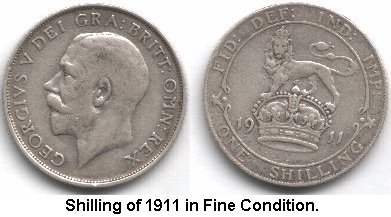
Fine or just F:
Click here for an Example.
Usually with earlier 'Milled' coins this is the first truly collectable condition and often very good value because sometimes there are considerable leaps in value between a Fine coin and the next grade up. Fine coins still show considerable wear to all raised surfaces. More detail should be visible on the designs and some of the main hair volume should be visible on the Monarchs head. Not individual strands, but maybe a parting or signs of head-dress. Many of the coins in your pocket even after just 30 years or less of use could probably be described as 'Fine'.
Very Fine or VF:
Click here for an Example.
A coin with some wear to the highest areas of the design but has seen limited circulation. More hair detail is evident and also detail on the other designs. Just as an average guide a coin that has been in normal circulation for approximately 5 years would probably qualify for VF status.
Extremely Fine or EF:
Click here for an Example.
A coin with little sign of being circulated. There may be only the slightest wear to the highest areas and minimal scratches and other marks. Usually some of the mint lustre is visible on coins of this grade. As a rough idea a coin in your change would probably be an EF if it had been lucky and was minted just 1 year ago.
Uncirculated or UNC:
Click here for an Example.
Like the name suggests the coin should be as it left the mint with no signs of circulation or wear. Not necessarily perfect though, because coins can pick up scratches and what's known as 'bag' marks during mass production and contact with other coins at the mint. The coin should have most of its lustre present and some dealers may expect 100% lustre on coins stated as Uncirculated. An Uncirculated coin would be given to you from a freshly opened bag of new coins in your change.
Brilliant Uncirculated or BU:
Click here for an Example.
BU is not an official grade but is often used to refer to an Uncirculated coin with full mint lustre.
Proof:
You may see a coin referred to as a 'Proof'. This is not a grade but the name given to a coin that is made using specially prepared dies (The dies are the inverted images used to strike coins) and often alternative metals. The flat areas of proofs often have a mirrored finish, and you can literally see your face in them.
Update:
As well as the basic grades listed on this page, collectors will often encounter grades like 'GVF' for example. This indicates the coin is not exactly a 'VF' (Very Fine). In fact the 'G' stands for 'Good' so a GVF coin would be better that VF but not quite EF.
The preceding letters encountered using the British grading system are: 'G' for Good, 'N' for Near and 'A' For about. The range between VF and EF for example looks like this: VF, GVF, NEF, AEF, EF.... And from F to VF looks like this: F, GF, NVF, AVF, VF.
Sometimes, mainly due to a coin being struck with one sides design slightly higher or more complex (giving better protection) it is possible that a coin will have less wear on the 'Heads' side than the tail (or vice versa). If this is the case you may see some coins graded as, for example VF/NEF. This does not mean the coin is somewhere between VF - NEF it means that the obverse (heads side) is Very Fine and that the reverse (tails side) is Near Extremely Fine. It is usual practice to list the obverse grade first.
This Modern coin grading Guide is © Chris Perkins 5th January 2003. Updated 19th December 2005 and 28th July 2015.
The world grading chart:
World coin grading chart.
Numismatic advice hub.
Comprehensive book on coin grading.
Read about Pre-decimal denominations.